
Chicken, Apricot and Chickpea Stew
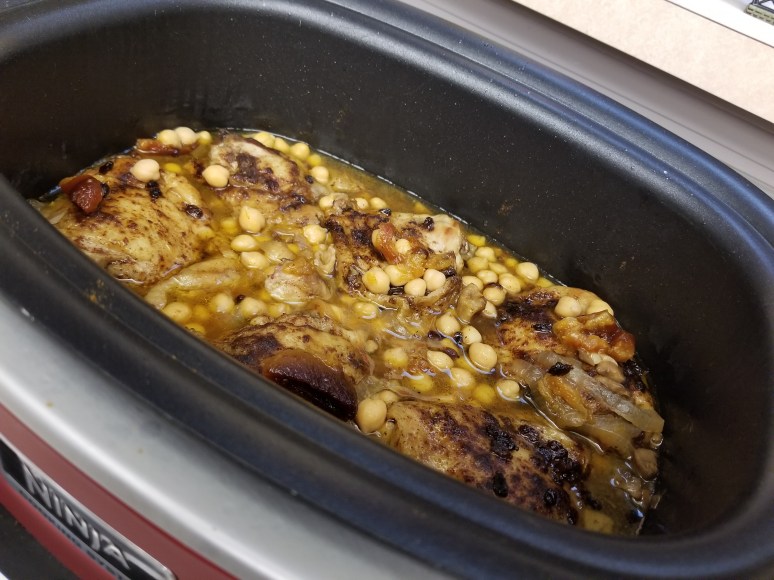
Yes, I know it’s been a LONG TIME since my last post, but that’s another story all together. (Besides,the re-learning curve on my recipe program is really steep!) Anyway, here’s what I’m up to today…
Perfect for a gray autumn or winter day, this slow-cooked stew is sweet and savory comfort food. Serve with rice or couscous and a medium dry red wine. Ras El Hanout is a North African spice mix. The name literally means “top of the shelf” and is made from the best spices to be found in any shop (sometimes as many as 50!) Most blends contain at least the following: ginger, cloves, black pepper, turmeric, cinnamon, cumin, coriander, and all spice,
INGREDIENTS:
6 bone-in skin-on chicken thighs
1 cup mushrooms coarsely chopped
1 large onion, sliced
3 cloves garlic, chopped
6 dried apricots, halved
2 tbsp dried barberries
2 tbsp ras el hanout spice blend
1/2 cup water
1 15-oz can chickpeas, rinsed and drained
Salt and pepper, to taste
PROCEDURE
1 Season the meaty side of the chicken thighs liberally with the Ras El Hanout
2 Brown the chicken thighs, skin side down, in a multi purpose cooker (I use a Ninja) or on your stove top in heavy bottomed, lidded casserole. Remove the chicken and set aside.
3 Lightly saute the garlic and mushrooms in the rendered chicken fat.
4 Change the setting to slow cook, If using a casserole on a stove top, turn the heat to a low simmer.
5 Layer the sliced onions over the mushrooms and top with the chicken thighs (skin side up).
6 Sprinkle on the halved apricots, the barberries, and the remainder of the Ras El Hanout.
7 Carefully pour the water down the side of the pan, taking care not to displace the spices, apricots or barberries.
8 Scatter the chickpeas around the chicken and press them gently into the liquid.
9 Cover and cook very slowly for up to six hours. Can also be prepared in a 250 degree oven.
Servings: 6
Oven Temperature: 275°F
Preparation Time: 30 minutes
Cooking Time: 6 hours
Total Time: 6 hours and 30 minutes
Stuffed Artichoke Bottoms with Shrimp, Capers and Marinara Sauce (serves 4)
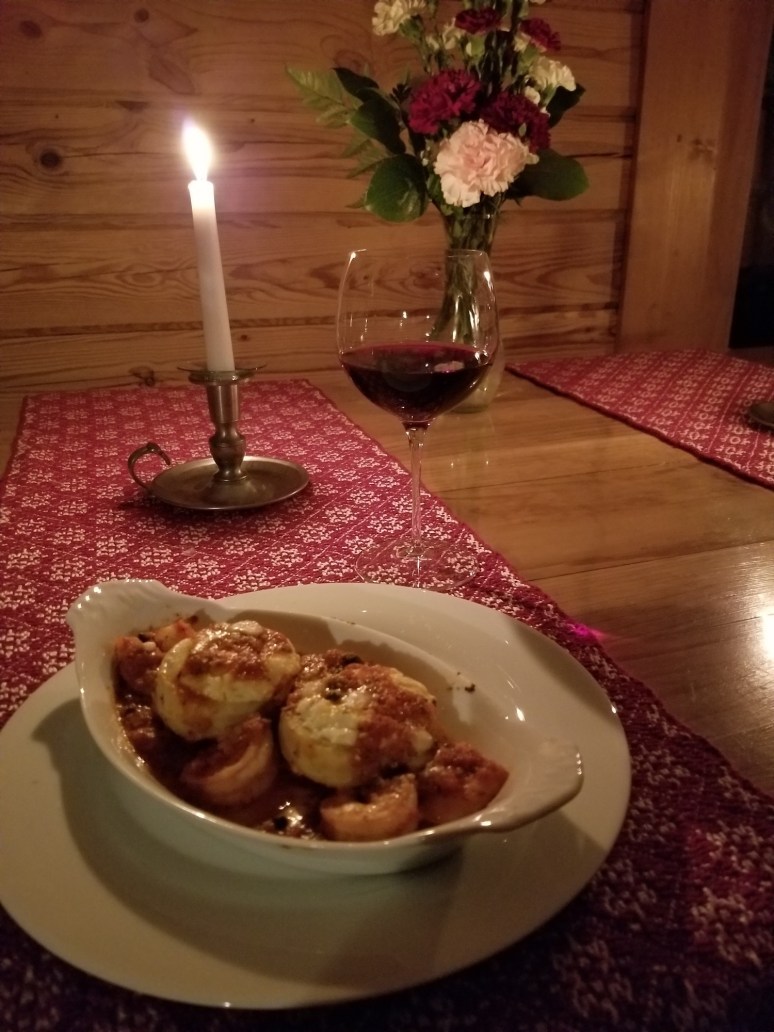
Stuffed Artichoke Bottoms with Shrimp, Capers and Marinara Sauce (serves 4)
Prep the Artichokes
2 cans artichoke bottoms drained and rinsed (about 8-10 artichokes)
Juice of 2 lemons (added to 4 cups water)
Soak the rinsed artichoke bottoms in the lemon juice and water for at least one hour. Drain
Prepare the Marinara Sauce
1 tbsp extra virgin olive oil
1 large clove garlic, minced
1/2 cup chopped onion
2 15 ounce can diced tomatoes
1/4 tsp red pepper flakes
1/2 tsp each basil, marjarom and oregano
Kosher salt to taste
1 tbsp capers, drained
Sauté the onion and garlic in the olive oil. Add the tomatoes and spices (but not the capers) and simmer for 30 to 45 minutes. Using an immersion blender, puree the sauce. Stir in the capers. May be made in advance and reheated.
Stuff the Artichoke Bottoms
8 artichoke bottoms (prepared as above)
1/2 cup ricotta cheese
1/4 grated parmesan cheese
1 egg
1/4 tsp basil
1/4 tsp dried tarragon
Salt and red pepper flakes to taste
Lightly beat the egg. Add the cheeses and spices and mix thoroughly. Lightly mound the stuffing into the artichoke bottoms. Place on a lightly oiled sheet of aluminum foil and bake at 425 for 10-12 minutes or until puffed and golden. Transfer to individual oven proof au gratin dishes.
Prepare Shrimp
1 lb large shrimp, peeled and deveined
Return the Marinara Sauce to a slow boil. Add the Shrimp and cook until just pink (about two minutes. Spoon the shrimp from the sauce and arrange around the artichoke bottoms on the au gratin dishes.
Use the remaining sauce to lightly nap the shrimp and the artichoke bottoms. Sprinkle with additional grated cheese. Place in the middle of a 425 oven for about 5 minutes or until thoroughly heated and the cheese melted. Serve at once.
Holiday Sweet Bread: Challah
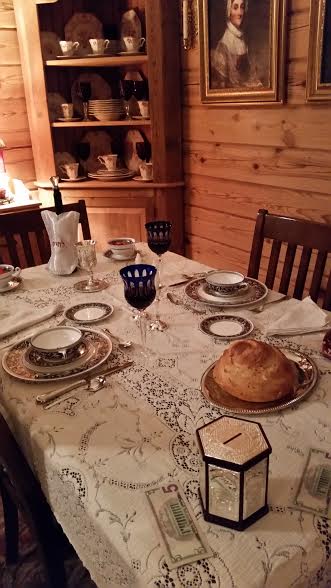
Challah: Holiday Fruit Bread
This is a wonderfully fragrant, moist and yeasty bread. Lovely to look and even better to eat! Give yourself plenty of time to enjoy the process from mixing to kneading to baking and serving. Glyn
1/4 cup dried apricots diced
1/4 cup dried cranberries
1/2 cup Granny Smith apple diced
1/2 cup boiling water
2 1/2 tsp dry yeast
1/3 cup sugar
1 tsp salt
1/4 cup butter (melted)
2 Duck Eggs (or 3 XL chicken eggs)
1 tsp ground cardamom
1/2 tsp ground cinnamon
4 cups all purpose-flour
1 egg (for brushing)
1 tbs. sugar
- Soak the cranberries and apricots in the boiling water for 20 minutes. Drain, reserving both fruit and water.
- Let the water cool to warm. Measure. If needed add additional warm water to make 1/2 Cup.
- Pour the yeast onto the warm water and stir.
- Combine the duck eggs, sugar, salt, butter, cinnamon and cardamom. Mix well.
- Stir in the yeast and water.
- Add the reserved fruit and 1 cup of flour
- Gradually add the remaining flour to create a slightly sticky but manageable dough.
- Turn onto a lightly floured surface and knead 10 minutes, adding additional flour if needed smooth elastic dough.
- Place dough in a lightly oiled bowl, turn to oil both sides. Cover with dish towel and place in an oven with light on.
- Let rise till doubled (about 1 and 1/2 hours)
- Line a baking sheet with parchment.
- Shape the dough as you wish. Braided, spiral, round loaf, or small individual loaves. Place on baking sheet.
- Brush with beaten egg and sprinkle with 1 tbs. sugar.
- Let rise again for 30 minutes.
- Preheat Oven to 350.
- Bake for 25-30 minutes or until the bread is golden brown and sounds hollow when tapped.
- Cool on a rack. Serve warm, toasted or at room temperature.
Servings: 12 Yield: One Loaf
Preparation Time: 30 minutes
Cooking Time: 30 minutes
Inactive Time: 2 hours
Total Time: 3 hours
Oven Temperature: 350°F
Nutrition Facts
Serving size: 1/12 of a recipe (3.6 ounces).
Calories 293.7
Calories From Fat (20%) 57.74
Total Fat 6.54g 10%
Saturated Fat 3.07g 15%
Cholesterol 128.8mg 43%
Sodium 219.7mg 9%
Potassium 130.71mg 4%
Total Carbohydrates 51.7g 17%
Fiber 2.58g 10%
Sugar 8.82g
Protein 6.83g 14%
Braised Oxtails
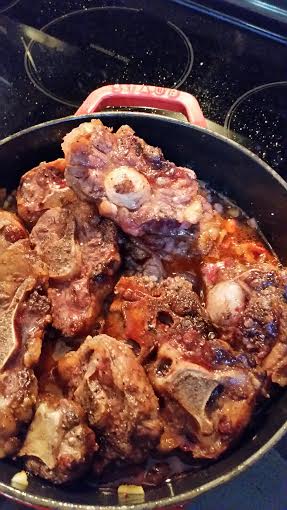
Here’s a variation on Osso Bucco made with oxtails rather than veal or beef shanks. It’s a lovely, savory, slow-cooked main dish perfect for a cold winter day. And if you don’t have time to make it all at once, do the active part in the evening, refrigerate over night, and cook on low in a slow cooker for 6-8 hours the next day.
You can use either red or white wine with this dish. Just make sure its a dry wine.
To keep it gluten-free, serve with polenta or rice. Otherwise, use your favorite noodles.
Bon Appetit!
Glyn
Ingredients:
2 tbsp olive oil
3 lbs beef oxtail
1 1/2 cups chopped onion
1 1/2 cups chopped celery
1 cup chopped carrot 1 tbsp chopped garlic
1 tbsp tomato paste (or dried tomato powder)
1 cup dry wine (red or white)
salt and pepper to taste
Procedure:
1 Preheat the oven to 300 F.
2 Pat the oxtails dry.

3 In a heavy, lidded casserole, heat the olive oil to medium high.
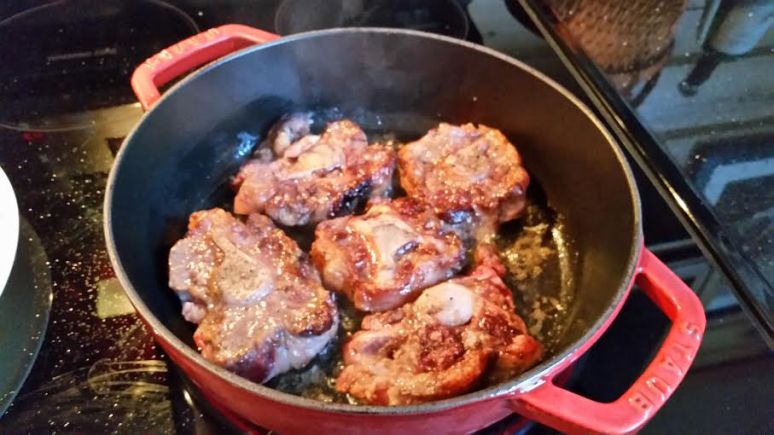
4 In batches, sear the oxtails on each side. Remove to a plate.
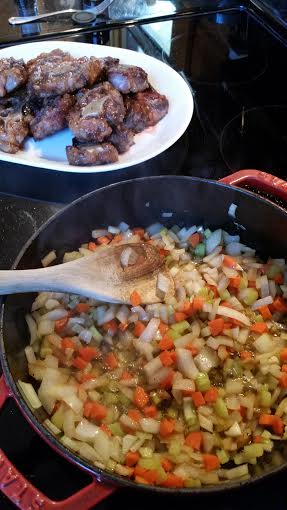
5 In the same pan, saute the onion, garlic, carrot and celery until lightly browned.
6 Remove from the burner and stir in the tomato powder or paste.
7 Return the oxtails to the casserole, placing them on top of the vegetables (in one layer if possible).
8 Add the wine.
9 Cover tightly and place in the pre-heated oven if you are cooking it all in one day.
10 Cook slowly for two hours,
11 If you are cooking in two stages, refrigerate overnight and use a crock pot or slow cooker the next day to complete.
Servings: 8
Degree of Difficulty: Moderately difficult
Oven Temperature: 300°F
Preparation Time: 10 minutes
Cooking Time: 25 minutes
Inactive Time: 2 hours
Total Time: 2 hours and 35 minutes
Nutrition Facts
Serving size: 1/8 of a recipe (6.2 ounces).
Recipe Type
Gluten-Free, Low-Carb, Main Dish, Meat

What to do with the left-over bubbly?
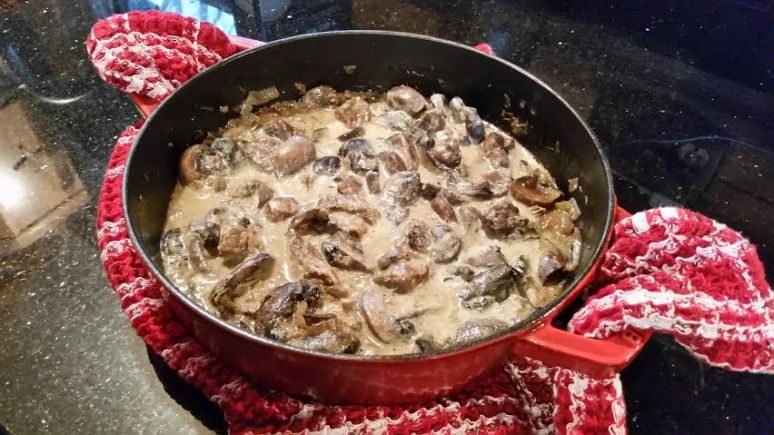
Beef in Champagne
Like many cooks and entertainers, I tend to over-shop at holidays. This year, in addition to a half-full bottle of completely potable California “Champagne,” I found myself with a pound and a half of Crimini mushrooms, a quart of whole cream, assorted nuts and cheeses, and enough produce to stock a small market. Much of it will keep long enough to see us through this week, but the mushrooms were staring down their “use-by” date, and the champagne (even when stored with a spoon in the neck of the bottle to preserve the bubbles) was loosing it’s charm.
Enter Beef in Champagne — a gluten-free, low-carb riff on beef burgundy (or stroganoff). It takes about two and half hours to prepare but it also sits for four hours. So if you get it into the oven in half an hour and set your oven to go off after two hours, you can leave and then reheat it at dinner time.
To keep things low-carb, serve it with mashed cauliflower or spaghetti squash. Or, if your New Year’s resolutions permit, serve with potatoes or over noodles.
Pair it with a nice salad, and a crisp dry wine — even champagne!
Enjoy,
Glyn
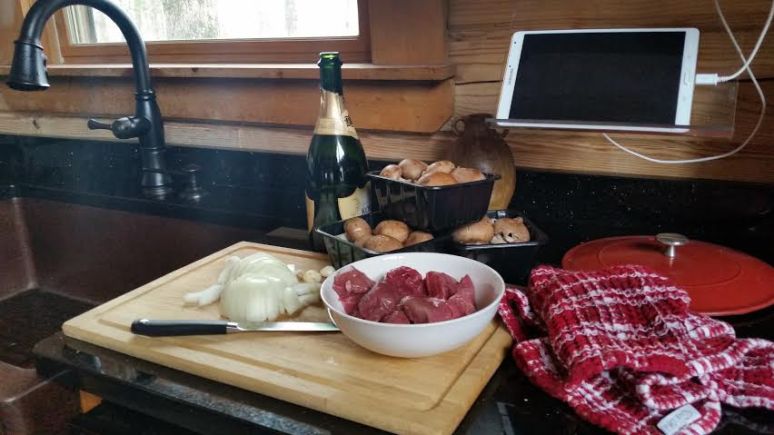
Ingredients:
4 tbsp olive oil, divided
1 lb stew beef chunks, cut intoi inch cubes
2 cups sliced yellow onions
4 cloves garlic, chopped
18 oz mushrooms thickly sliced 1/2 tsp dried thyme leaves
1/4 tsp salt (or to taste)
1/4 tsp black pepper to taste
1 1/2 cups Champagne or White Wine
1/2 cup sour cream (OPTIONAL)
Procedure:
1 Heat half the olive oil in a heavy sauce pan or oven proof lidded casserole.
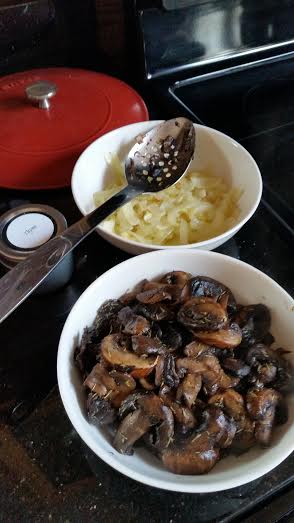
2 Sauté the onion and garlic until translucent and slightly golden in color. Remove to a bowl.
3 Turn the heat to medium high. Add the mushrooms to the pan and sauté until they have released and re-absorbed their liquid — about 15 minutes.
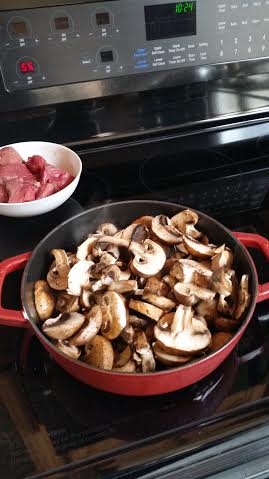
4 Season with salt, pepper and thyme. Remove to a bowl.
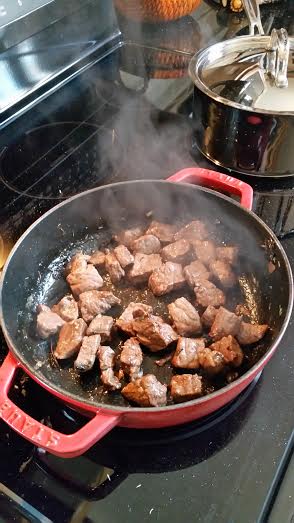
5 Pat the beef cubes dry. In the same pan, add the remaining olive oil and sear the beef. If it is too moist to sear, just cook until the liquid evaporates.
6 Return the onions, garlic and mushrooms to the pan with the beef, Stir well.
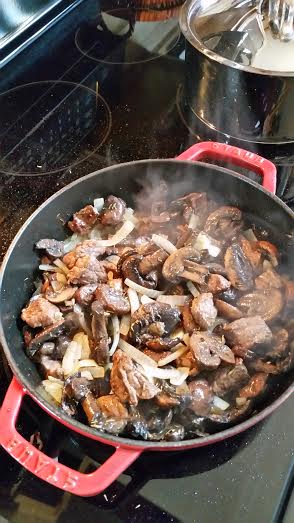
7 Add the champagne and let it bubble for a moment or two.
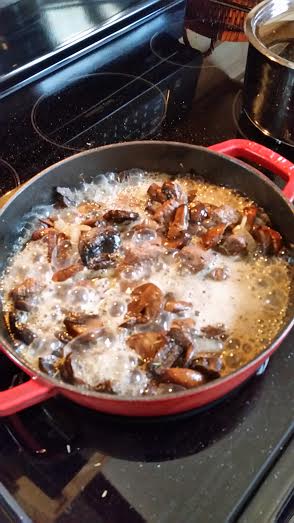
8 Lower the heat, cover tightly and simmer for two hours. (Or bake in a 275 degree oven.)
9 Let sit for up to four hours (or overnight in the fridge.)
10 Reheat before serving, cooking down the sauce to your preference.
11 For an even richer dish, stir in a half cup of sour cream.
Servings: 4
Degree of Difficulty: Moderately difficult
Preparation Time: 30 minutes
Cooking Time: 2 hours
Inactive Time: 4 hours
Total Time: 6 hours and 15 minutes
Nutrition Facts
Serving size: 1/4 of a recipe (14.8 ounces).
Recipe Type
Gluten-Free, Low-Carb, Main Dish, Meat
Nutrition Information:

A Body and Mind in Sync
First Day of Winter. December 21st. 3:30pm on the eastern edge of the central time zone. It’s grey, foggy and wet. The dusk is so deep that the holiday lights have come on. Today is the shortest day of the year in the northern hemisphere; a moment when the wheel of the year turns again toward the lengthening of days and the coming of Summer.
In previous years, I was at work on this day. I would have noted the ever earlier sunset and perhaps have driven a bit more carefully on the way home through the wooded hillside of Pennsylvania; conscious of the altered routines and challenged circadian rhythms of my fellow creatures. But the Solstice would have remained an external phenomenon. It would not have had the power to alter my daily rounds.
Today is different. I have walked these hours through a liminal landscape. My brain has been aware of the time of day, the events on the calendar, the household chores at hand. My body, however, has insisted that I listen to the rhythms within. I have been sitting quietly. Reading, thinking, deeply aware…deeply at peace. And when after lunch I felt the pull of sleep, I did not fight it. Wrapped in an afghan, I stretched out on the sofa and slept, allowing my body and brain to operate for once in tandem, cradled and motionless in the arms of the gathering dark.
Today is a special day. My heart, body and genetic memories know it. They always have. But today, my mind has known it too, and joining my spirit, has entered into the deep peace of winter.
This is good. Very Good.
Scrooged: Misanthropes Among Us

Unlike most other adaptations of Dickens’ Ebeneezer Scrooge, Bill Murray’s portrayal of Frank Cross in “Scrooged” leaves us with little doubt as to his basic character. This Scrooge is not just a misanthrope, he’s a jerk. There may well be all sorts of mitigating circumstances in his past, but the fact remains that this guy actively enjoys bullying, humiliating and generally riding roughshod over everyone in his path. In fact, his redemption, when it comes, is not achieved by his learning something about human decency. Nor is his heart softened by the realization of his connections to the lives of others. Frank Cross has to be terrorized into rejoining the human race.
Thing is, it works. Which makes me wonder…
Spiritually speaking, what would it take to put the fear of God into most of us? Not in the sense of punishment, eternal damnation and all that stuff. In the long run, those things never work; they just temporarily change our behavior.
Fear, in the biblical sense, refers to awe and reverence. In that context, to fear God means learning (among other things) to recognize our place in the creator/creature relationship and to respond appropriately. It takes us down a few notches in our estimation of our own centrality in the universe. It also has the effect of reminding us of the necessity of others in our journey through life. It’s hard to become fully human all by yourself.
But becoming fully human is exactly what we have to do. It won’t be easy and because few of us are naturally altruistic, we might have to start from the perspective of enlightened self interest instead. After all, unless we learn to get along, we’re likely to destroy ourselves and our world. But maybe, together, we can learn to offer each other the respect we deserve, and to reverence the image of the divine which we all bear. What a great Christmas Gift that would be.
It’s A Wonderful Life

Unintentional narcissism seems to be the abiding sin of our age. We are so wrapped in in monitoring how we feel, what we need or want, or what others think of us that we seldom stop to think about what our presence might mean in this world.
We don’t do it because we are selfish. Most of the time, we’re not even aware that we are doing it. We are narcissists because we are afraid. Afraid that we are not good enough. Afraid that no matter how hard we work or deeply we love, loss and sorrow are only a heartbeat a way. It’s a very effective method of wasting time and never quite engaging reality. It’s also a humdinger of a way to live and die without ever recognizing that life is wonderful — even when we don’t know it. Even when we are to tired, or worried, or angry to notice, this is still a wonderful life.
Because life is wonderful all on its own. And as George Bailey comes to know, while that wonder is enhanced by our presence and participation — especially in the our impact on the lives of others — life’s wonderfulness is not contingent on our efforts. In other words, we don’t have to make life wonderful. It just is.
So today, let’s all throw our hands in the air, take a deep breath and jump headfirst into the wonder. It’s there for us, just waiting to be noticed.
Movies in Advent ~ White Christmas

We watched White Christmas last night, and today I am wondering just what it is that makes this film so enduringly endearing.
In a word, “Values.”
Yes, it’s nostalgic, simplistic, dated, and corny. The romantic angle is implausible. The plot concerns Christmas only in that it takes place over the holiday season. It doesn’t even endorse our culture’s obsession with consumerism and Rockwellian family gatherings. But it does remind us that those who have endured and survived genuine hardship most often have the best sense of perspective.
Because the main character of the film is not any one person. It is the relationship forged in the forced community of an army at war. These folks have been tried in the fires of world-threatening conflict, and the experience has taught them the value of friendship,loyalty,and respect.
So when a group of hoofers and grunts give up the comforts of a fireside Christmas Eve to say “thank you”, we understand. Maybe we even get a bit teary.
Unlike the fear-based, comfort-driven and often selfish motives of modern life, “White Christmas” celebrates real human values. We need that more than ever.
Stealth Christmas
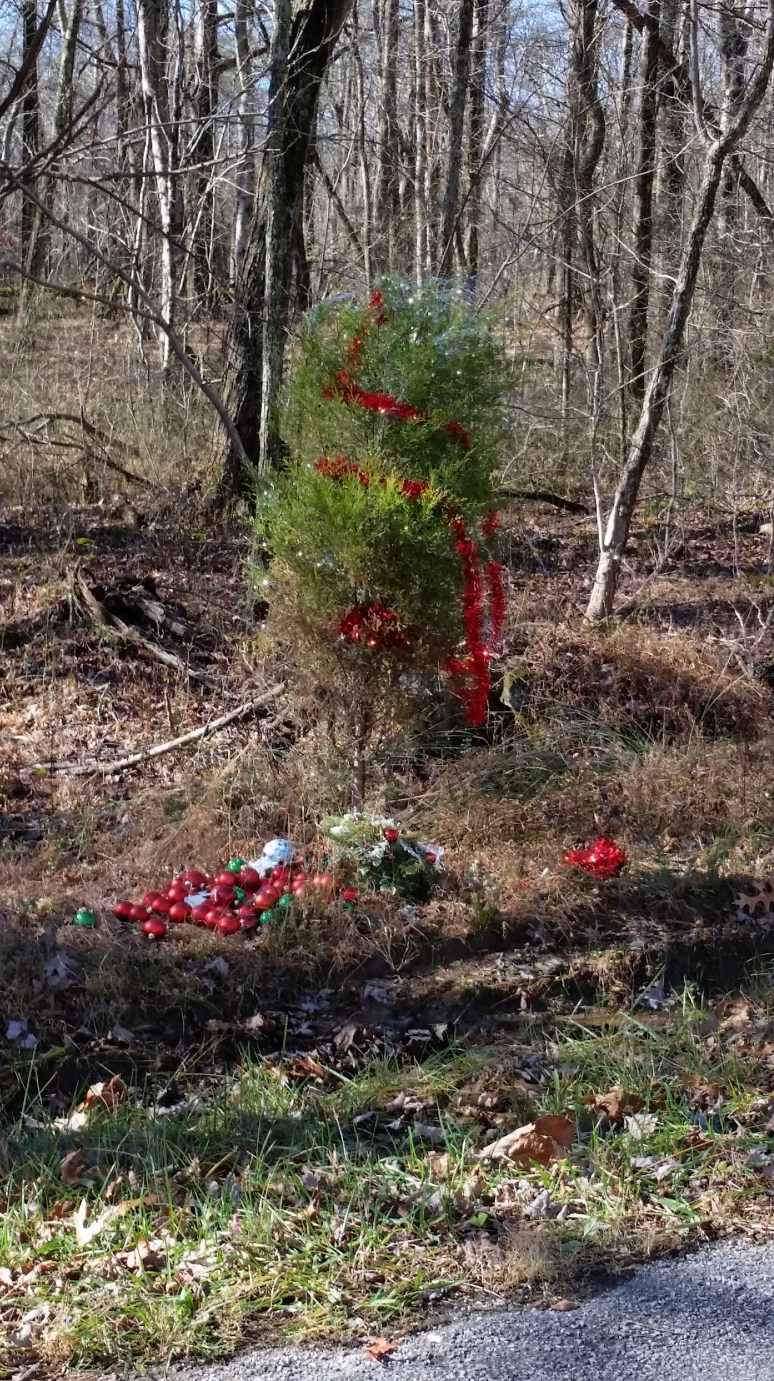 No one gets upset if you say “Merry Christmas” in our neighborhood. No one is offended if you don’t, either. It’s not that we don’t care about such things, it’s that we care enough to let folks be. We also do some pretty cool stuff around the holidays.
For example, someone has been doing some stealth decorating on a little pine growing in an empty patch of wooded lot on the side of the road. Each day, the little tree grows more festive. First a star, then some red garland and some icicles. last night someone added some battery operated lights, and today there’s a pile of ornaments on the ground at the base of the tree.
As it turns out, there is more than one “someone” involved. I surprised one of them when I stopped by to take a photo today. He confessed to placing the icicles on the tree, but wanted to give others the credit for everything else. “We just enjoy it,” he said. “Thanks for appreciating it
I do appreciate it! Not just for the holiday cheer, or the neighborhood beautification, but for the obvious joy of the effort. Folks care enough to do something good, and to do it anonymously.
That’s the real spirit of Christmas.
Our Lady of Guadalupe

Today is the feast of our Lady of Guadalupe for whom I hold a special devotion. On this day, I am reminded of the importance of sensible evangelism, especially when ministering with indigenous peoples. The truth will be recognized and embraced by those who are seeking the holy. We need never impose our metaphors at the cost of theirs. Our job is to present the good news and to allow the holy spirit to present the resonances to those to whom we speak. Our Lady of Guadalupe wears the garb of the Americas, and in doing so has led millions to her son. There is a message and a lesson for us all in that .
There’s Always a Bigger Fish

I’ve been reading Claire North lately, especially the Game House novellas. Her premise revolves around the concept of gambling/gaming as a means of taking charge of one’s own life. Perhaps we wish to escape a violent or abusive relationship. Maybe what we really desire from life is the security of having power over a nation’s political and economic life. Maybe we are just plain bored. In every case, if we are shrewd, patient and willing, the House will provide a game for us. If we win, we grow more powerful; if we lose, we risk the loss of whatever we hold most dear. The House knows what we value and just how to prod us into making and accepting ever more risky wagers.
And if that is not sufficiently sinister, the House awards winners with the services, even lives, of lesser Gamers who have lost enough to have become indentured players. They are the game pieces awarded to those more adept at playing the Game.
Despite the House’s claims that every game is fair and balanced, and the ubiquitous presence of white robed “umpires” to assure that the rules are obeyed, everyone knows that the games are “fixed.” Still, the lure of success is addictive, and the house keeps upping the ante for those who believe that they can win.
But, as Obi Wan Kenobi once quipped, “there is always a bigger fish,” and every player is also a piece in someone else’s game.
The thing about good fiction, and Claire North/Catherine Webb’s fiction is excellent, is that it provides a mirror into our own lives. Along with affluence and the relative comfort provided by the pursuit of success, often come boredom, a craving for more, and an indifference to that fact that once we begin viewing life as a game, we run the risk of ceasing to be people. We all become pieces on the board.
Faith offers an alternative. The cost and promise of faith is liberation. True, it is a risky business to be free, for then we may no longer blame anyone else for our problems. But being free also provides an extraordinary gift – that of perspective – of knowing one’s place in the universe and of recognizing the ultimate poverty of using others to make ourselves feel better.
The truly free know that one of the surest ways to die is to live in dread of the arrival of a bigger fish. Such a zero-sum game mentality will ensure that the greater predator will always find and in the end, devour us. The truly free know that true love, power, and strength appear in the most unlikely places – even in mangers.
Advent offers us freedom. It invites us to step away from the game, and to enter into life.
Balance and Perspective

This time of year we have to organize our lives around the possibility of being fogged in. Fog around here can be so dense that you literally cannot drive. And if you are out and suddenly encounter an unexpected patch, you’ll need a spotter in the passenger seat with the door ajar to tell you how close you are to the edge of the road. Sometimes it’s so bad that when you come to an intersection you have to listen for traffic before inching forward. Life on the edge of the Cumberland Bluff requires planning and cooperation.
It’s a bit foggy today on our little spot of the bluff – maybe a 6 out of 10. Not so much that I can’t drive, but enough to make me concerned about just how foggy it is between here and the market. And that is a problem because I’m out of coffee and the presence of coffee in my life is non-negotiable. I could call a neighbor to see how foggy it is where they are, or I could post on the community news page to ask about the traffic, but again, that would only tell me how bad it is in that particular spot. There is only one way for me to find out. I will have to venture forth into the fog…but carefully.
That’s a good metaphor for finding our path through life. We can rely on the witness of others, which is often invaluable but inevitably partial; or we can find out for ourselves. Eventually we realize that there are times when the only way we can get what we get to where we need to be is to step out the door and into the fog. In doing so, we may discover that the densest of fog dissipates just around the bend in the road. Of course, we also run the risk of stepping off the edge of the cliff! That’s why we need the perspective of others, balanced by our own experience. Because life is not as simple as we would like. Choices are difficult. Opinions are cheap and abundant. It is easy to lose our footing, and even easier to lose our way by abdicating responsibility for making our own choices.
Dancing Toward Christmas

I was an English major before I was a pastor, and sentimental as it is, I really like the writing of Charles Dickens. Mind you, no one would who’s actually read them would suggest that his works are overtly Christian. (He was most certainly influenced by the Social Gospel of 19th century Anglicanism, but he’s definitely not a proponent of orthodoxy.) Which is why I find it all the more interesting when film versions of “A Christmas Carol” give even so much as nod in the direction of the church – think Patrick Stewart stopping by the local parish for a few rousing carols before heading off to dinner with the family. For Dickens, the redemption of Ebeneezer Scrooge is clearly secular and humanist.
So, when in the final scene of the Albert Finney musical version of the tale, over-the-top prodigal Scrooge is transformed into Father Christmas and leads the parade of street urchins, tradesmen, bell ringers and Morris Dancers through the streets of London, we hardly need the insertion of vicars and choir boys to tell us what is going on. But the screenwriters and directors obviously thought it would provide a fitting touch, so they did.
Thereby providing us with a wonderfully ironic example of how when the church is out of touch with the people, the parade may just have to come to the church.
Two world views collide. And when the raucous celebration of Christmas, led by the greatest reprobate of all, confronts the precise piety of staid and proper worship, guess which prevails. It takes a moment or two for the choir boys to break ranks and join the parade, but they do. Even the nonplussed vicar manages a bit of modest (if out-of-tempo) participation. And, at least for a moment, the world is a better place.
Just saying….

Advent Afternoons: Because Sometimes Things Really ARE Complicate
My sister, Deborah Ruppe-Rogoff, sent me a link from the British Museum’s Waddesdon Bequest collection, last night and asked me to write about it. She was intrigued by the complexity of the Tabernacle’s artistry, and the obvious love, talent, and devotion of its creator. I agree.
I am also struck by a couple of other things.
First, this extraordinarily intricate and beautiful piece is Christian in its theme, but it came to the British Museum in the late 19th century as a bequest from a Jew. It had for centuries been part of private collections, but Baron Ferdinand Rothschild was not just a collector. He was also a philanthropist and realized that things of beauty should be shared as well as preserved. The medieval creator of this piece might well have hated the Baron for being a Jew. But a Jew and his family preserved the artist’s work and made a gift of it to the world. There’s a lesson there.
Second, in contemporary parlance, a Tabernacle is often a house of worship or a liturgical fixture which houses a sacred object (a Torah Scroll, the Reserved Sacrament, etc.) But in its origins the word described the place where the Shekinah/Presence of God dwelt. In fact, Scripture speaks of God living with, travelling with, in fact, “tabernacling” with the people.
So the word is not only a noun, describing the place where the Holy dwells, it is also a verb.
In a time when it is so tempting and so easy to objectify our faith, to remove it from the realm of action, or to permanently enshrine it in an object, a place, a person or an event, we need to remember that. Faith must never be static, it is active and mobile.
Third, this artifact is a thing of beauty, whose full glory is only revealed by opening it up, examining its intricacies and entering into its mystery. But that isn’t all. As the curator points out, you have to be able to put it back together again; and that must be done with care and attention to how the various parts fit and work together. Otherwise we do violence to it, and to its creator.
In Advent, we are invited to prepare a dwelling place for God. We set our crèches, and decorate our homes and churches. But we are also asked to prepare our hearts. Advent provides us with an opportunity to explore the divine intricacies of God’s presence in the world, and to open our hearts and minds to the miracle before us. We live in a world that desperately needs to be opened up, understood, and appreciated. But the task must be undertaken with the utmost attention to what we are doing, to whom we are doing it, and in whose name and on whose behalf we are acting.
Light One Candle: Don’t Let the Light Go Out
Hanukkah began at sundown last night, and it seems especially appropriate as we Christians enter the second week of Advent and light the second candle on our wreaths, to remember that light is not ours alone. As a metaphor, light is central, not just to this time of year, but to celebrations of faith throughout the world.
So, In a day and age when so many things conspire to quench the light and destroy hope, this song is a wonderful reminder of the power of faith, action and memory. It’s message is timeless, and contains a lesson for all of us.
https://www.youtube.com/watch?v=h1cRXgDFiSs (Peter, Paul and Mary)
Light one candle for the Maccabees’ children
With thanks that their light didn’t die
Light one candle for the pain they endured
When their right to exist was denied
Light one candle for the terrible sacrifice
Justice and freedom demand
But light one candle for the wisdom to know
When the peacemaker’s time is at hand
Don’t let the light go out
It’s lasted for so many years
Don’t let the light go out
Let it shine through our love and our tears
Light one candle for the strength that we need
To never become our own foe
And light one candle for those who are suffering
Pain we learned so long ago
Light one candle for all we believe in
That anger not tear us apart
And light one candle to find us together
With peace as the song in our hearts
Don’t let the light go out
It’s lasted for so many years
Don’t let the light go out
Let it shine through our love and our tears
What is the memory that’s valued so highly
That we keep it alive in that flame?
What’s the commitment to those who died
That we cry out they’ve not died in vain?
We have come this far always believing
That justice would somehow prevail
This is the burden, this is the promise
This is why we will not fail
Don’t let the light go out
It’s lasted for so many years
Don’t let the light go out
Let it shine through our love and our tears
Advent Afternoons: Every Year Is A Jubilee

Since retiring we often worship at the local Methodist Church, which is literally in our neighborhood. We like it: the preaching is excellent, the congregation is friendly and welcoming, and because Methodists are not compelled to wait until Christmas Eve to sing carols, we’ve been singing and studying Christmas carols this Advent. Today the chosen carol was “Angels we have heard on high.” The sermon focused on the line, “Shepherds, why this jubilee?” Why, the townspeople wondered, were these particular folks, largely unwashed and unlearned, chosen to share the good news of the birth of Jesus? What did they do to be chosen to start the party? Why indeed.
Thinking about this carol this afternoon, I am further struck that the choice of the word “jubilee” in the text of this old French song is precise and essential. Bearing such good tidings was more than ample cause to be jubilant. These shepherds were most likely neither poets nor philosophers, but they would certainly have understood the idea of Jubilee. And for them it would have been far more than a festival, party, or celebratory event. Jubilee was an extraordinarily important, though frequently ignored, concept to our ancestors in the faith. It was the time, once every 50 years, when debts were to be forgiven, slaves and prisoners freed, and lands held as collateral restored to their owners. It was a time of liberation. For folks like shepherds, living on the edge of society, such respite from the weight of their worlds would have been great news. And even if it didn’t really happen (human beings being what we are), the theme of jubilee represented hope, and the promise of better times to come.
Like Advent. Every year we return to our spiritual roots in hope that this year, when the baby arrives, we will recognize him, worship him, and imitate him. Jesus is the ultimate expression of our jubilee, but his appearance is not limited to twice a century. He is with us every day. Every moment is an example of liberation. Every year is a Jubilee year.
Perhaps that is why we continue to sing, and to hope, even when the experience of our daily lives tries to convince us that we are only dreaming. Maybe it is because deep in our hearts, we all feel the tug of the angelic message. Maybe we all want to be shepherds, doing our best to trust the assertion that God is with us, while making our way to Bethlehem to share the news with others.
Advent Afternoons: The Eve of St. Nicholas

On the Eve of St. Nicholas
My grandsons love St. Nicholas, but they’ll run away screaming if Santa Claus comes into view. After all, Santa is a big, loud critter who sees and knows all and sends out elves to sit on your shelf and tattle on you, while St. Nicholas is a church-sanctioned saint who protects children (also sailors, brewers, pawn brokers and others) and leaves chocolates in your wooden shoes.
Don’t get me wrong. I’m 65 and I still believe in Santa. But I can also understand how the idea of being under behavioral surveillance by some huge hairy dude who can either make your day or take away your toys can be a bit unsettling to toddlers, especially when they are still learning to navigate the world of parental and societal regulations.
Sad, then, isn’t it, when we understand God the same way? Be good, believe the right things, follow the rules and you’ll go to heaven. If you don’t, well, you’ll get what you deserve and it won’t be fun. Hard to get excited about that.
Thankfully, that’s not what our faith (or the season of Advent) is about. Among other things, Advent is about imitating St. Nicholas. As a fourth century Bishop in Turkey, he was known for his attention to the needs of others. He was able to understand that the best way to help folks look forward to and prepare for the coming of Christ was to be Christ-like himself. He helped the helpless, the vulnerable and those who might not have been on the A-list for Christmas invitations. And most of the time he did it anonymously. (By the way, that part about hanging your stockings on Christmas Eve. Legend has it that he tossed coins through an open window to help impoverished and dower-less sisters. He didn’t sneak into their home, and he didn’t climb down a chimney. The coins fell into their socks as the laundry hung near the fire to dry.)
Anyway, St. Nicholas is a huge part of Advent. He embodies a spirit of eternal love and hope while we live here in the mean-time. That’s why we need folks like St. Nicholas. We need to be able to trust in goodness and to look forward with joy to the presence of God in the world. We need to be able to rejoice in the presence of the divine in the face of an infant. We yearn to be safe, warm, loved and sheltered. And, truth be told, we want to be able to make other people feel that way.
So, for Nicholas and all the Saints of God, we give thanks!
Advent Afternoons: Falling Over the Side

As the eldest of five siblings, I was required to do a lot of baby-sitting. So much, and often so begrudgingly, that my family expressed some degree of amazement that I ever had children of my own. To my eleven year old self, watching my five year old brother was an especially onerous assignment – not because he was difficult, but because he wanted to do the same thing over and over and over. His favorite activity was playing “Sea Hunt”. It involved my “driving” the bed/boat while he (a la Lloyd Bridges) repeatedly curled up and rolled off the side into the ocean/pile of pillows. He loved it. I thought it was stupid. If you want to roll off the bed, I thought, just do it. Who needs a script and a cast, let alone an audience? (yes, my preteen self was already obnoxious enough to hold such judgmental opinions.)
Well, my lack of imagination – not to mention my dearth of sibling charity – meant that I lost out on the opportunity to join my brother in collapsing into giggles while falling over the edge to one of life’s few soft landings.
The observance of Advent is a bit like Bob’s delight in rolling over the edge. We do it every year, with relatively little variation in script; pregnant with potential, we approach this season in one of two ways — either with an elder sister’s sense of duty or, if we’re lucky, a preschooler’s sense of wonder.
But how often we trudge through these days in December without allowing ourselves to be drawn into their joyous sense of drama and anticipation! How often we have sat at a safe and cynical distance while those with more imagination have plunged into the welcoming seas of preparation.
We’re still in the first week of Advent. There is plenty of time to change our hearts and minds…time to slip into the life-giving waters of prayer… or to bounce on the pillows of hope.
Advent Afternoons: Sorry We Missed You ~ Please Come Again

It’s official. Jesus came and we missed it. Now, we’re all extras in a Mad Max world where there are only two kinds of people. Those who have legal access to all they need to wreak havoc and create mayhem, and those who cower in fear of them.
And the only theological reason I can offer for this state of affairs is that despite our collective prayers and piety, the Second Coming has already taken place. Jesus arrived, took a good look around, threw up his hands in disgust and went back to heaven. Now He’s leaving us to stew in the toxic brew we’ve created here on earth. At least until we decide to climb out of the muck and take responsibility for the colossal mess we’ve made.
For a start this Advent, maybe we should be honest enough not to sing O come, O Come Emmanuel. We clearly don’t mean it, or we’d be doing something to be more prepared for his return. Rather than tut-tutting over mass murder, genocide, or xenophobic press conference, we’d be confronting the perpetrators and acting to challenge them. We would be teaching our children to respect life. We would be examining and reforming the attitudes (especially the religious ones) that nurture violence. And we would be insisting that all elected officials, in ALL political parties, work for us rather than for the powerful few who pay to keep them in office.
Most of all, we’d grow some moral backbone. If we are to live in a land that is stalked by violence, if every gathering is only one madman’s whim away from dissolving into a hail of bullets, we could at least be honest about why so many of us are dying. We could admit that we are reduced to cowering in fear because we lack the will to stand up and speak the truth.
And yes, we should pray. But prayer without action is less than worthless. It’s hypocrisy. Jesus isn’t going to fix things just because we ask – especially if our prayers are a just one more example of our moral cowardice. We have to learn to pray that God will help us find the gumption to get up off our kneelers and go nose-to-nose with violence – not by arming everyone to the teeth and engaging in some grand OK Corral free-for-all, but with the courage to change and be changed by the task ahead.
Then, maybe, the words “from our fears and sins release us,” might make some sense.
Advent Afternoons: Grilled Cheese on Wedgewood
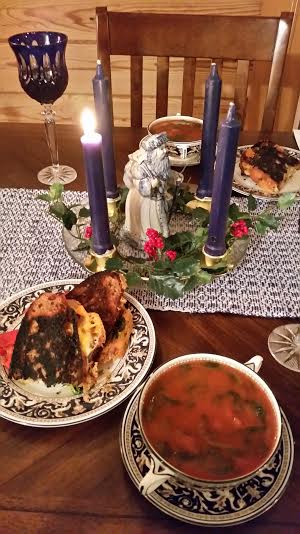
I own two place settings of lovely “vintage” Wedgwood china, which I normally reserve for special events. Lately, however, I have begun to realize that saving things for special occasions most often means not using them at all…or at the least, being embarrassed at how few things I actually consider “special.”
So, yesterday we had our tomato soup and grilled cheese on Wedgwood Florentine. I don’t know that it tasted any better than it would have on the everyday dishes, but it accomplished what I intended – Tuesday in the First Week of Advent became a celebration.
Life is brimful of opportunities for grace and gratitude. Advent is a reminder that the days leading up to feasts and holidays are not to be shunted aside as moments “in the meantime.” For, it is precisely “in the meantime” that we live 99% of our lives. It’s where we expend most of our energy; and if we are not careful, it is where, by rationing love and joy, that we waste our most precious hours.
The Advent journey brings us to Christmas. And like any journey, it takes time and awareness. But Advent is part of, not separate from, Christmas. So “haul out the holly” or at least dust off the good dishes. Laugh, love, celebrate the now. Doing so will not diminish your appreciation for Christmas, it will help put things into perspective.
Peace and Blessings,
Glyn
Advent Afternoons: Infantilizing Incarnation
My favorite metaphor for Advent is “Prepare the Way of the Lord.” Not as in John the Baptist or the prophet Isaiah, but as in Mary the Pregnant Virgin. She had a lot of preparing to do. She had to be ready to give birth, alone, far from home, and in less than pleasant circumstances. But she and Joseph also had to be prepared to raise a child whose very presence was going to cause a lifetime of raised eyebrows. We can understand how it might have been very tempting for them to remain in the manger, uncomfortable as it no doubt was. At least it was anonymous.
We are similarly tempted to idealize, and therefore, infantilize Incarnation. We want to build a manger and move in.
True, In God’s economy, the birth of this child, was enough. It was sufficient to heal and save us. In fact, the birth of every child has the potential to mend a broken world to the extent that it reminds us of our shared humanity. Babies inspire us to imagine what might come to be. But babies seldom save us, especially from ourselves.
Bacause babies, even the Son of God, outgrow the manger. The walk, talk, and make messes. They question authority, and confront injustice. And sometimes, like Jesus, they grow up to be such a nuisance that they get themselves killed. The baby in the crèche grew up to be a man who embodied the Reign of God even when it cost him his life.
In Advent, we prepare the way of the Lord. We recreate the circumstances which will make us ready to offer shelter and comfort to the tired and frightened family Holy Family. We seek to invite new life into our own tired and frightened souls. We yearn to provide a time and a place for God’s light to enter our hearts and lives.
And so we prepare the manger. But we must do so in the context of the whole story, for the crèche does not stand alone. It is the point from which we embark on the journey. Incarnation envelopes all of life and all of time. Emmanuel, God with us, is present in the baby, the youth, and the man. He will not remain an infant. We cannot hold him back. We can either walk with him, or walk away.
Peace and Blessings,
Glyn
Advent Afternoons: Come Along and Bring Your Brother.
Today is the Feast of St. Andrew and the weather here on the Cumberland Plateau is doing its level best to approximate the grayest wettest Scottish November possible. I also have a head cold and an ear ache, so be forewarned…I’m grumpy.
In the prayer for this day, we are invited to remember that not only did Andrew hear and respond to Jesus’ call to follow him, he went and got his brother, Peter, and brought him along as well.
I sort of doubt that would happen today.
The whole idea of brotherhood has seen some really lean times lately. Like “neighbor” we have defined the concept “brother” so narrowly that it often doesn’t even include our biological siblings. Brothers (and sisters) are understood to be those who agree with us, who share our “values” (for good or ill) and who don’t threaten or embarrass us. It makes for a pretty exclusive family; and, by-the-way, frees us from the responsibility of taking Jesus seriously.
If the Gospels are any indication, St. Peter could not have been an easy brother to live with. But the season of Advent begins with the example of Andrew going out of his way to bring him into a relationship with Jesus. Andrew could have chosen to make the journey into discipleship, and to foster his friendship with Jesus entirely on his own. But he didn’t. He cared enough about his brother to want to share the Good News. So he delayed his own experience long enough to go and get his irascible brother, Peter.
Maybe Advent is inviting us to do the same? Maybe, rather than erecting barriers to protect ourselves from the reality of our shared humanity, we should be looking for ways to expand the concept of brotherhood to include as many folk as possible. Maybe bringing our brothers along is the best way to get there ourselves.
Afternoons in Advent: Do you remember “lay-away”?

The local Fred’s in our community has “lay-away”. The last time I knew about such an arrangement was in 1970 when I worked as a clerk in the Ladies Gloves and Hosiery department of a department store in Blacksburg, Virginia. Folks planned ahead in those days and often did their Christmas and holiday shopping through the deliberately intentional and economically wise process of “layaway.” You chose your item, put 10% down and made weekly payments until your purchase was complete and you took your merchandise home. It made a great deal of sense, and combined with the ready availability of Christmas Savings Accounts (remember those?) was a grand alternative to impulse buying and credit card debt. I was making $1.60 an hour in those days and both those options were god-sends to my budget.
The Season of Advent, if approached with the same degree of intention, can be an excellent Lay-Away Plan. Make a small down-payment of Christmas Spirit. Then, every day, add a little something in the way of prayer and action, and come December 24th, you’ll be in good shape. What may have been impossible in one large effort will be complete and ready for wrapping, sharing, or enjoying. You’ll have achieved what you intended, your expectations will have been realistic, and you won’t be either spiritually broke or emotionally exhausted.
This year, enjoy Advent. Make the season a journey into the great crescendo of joy that is Christmas; and do it at a gentle pace, with the grace of gratitude, and the peace of mind that will allow you to arrive at the manger with a glad and joyful heart.
Glyn
Irony
So, I was all set to write a raucously appreciative and sentimental piece about yesterday’s inter generational Thanksgiving at my son’s house. Watching my firstborn roast and carve a turkey while three generations of extended family were sneaking up to “steal” chunks of the steaming bird; weeping quietly over the tearful grace offered by my daughter-in-law; arriving one second too late to prevent the two year old’s grabbing the gravy boat and anointing the table cloth; and watching the four year old tossing a “cheese head” at the ceiling while shouting “fireworks!” Priceless. Glorious.
And then I saw a meme on FB. A photo of a homeless veteran — his face painted as an American flag –and an invitation to “share” if I agreed that his needs should take precedence over those of immigrants and refugees.
Why? Why must I choose? Both the homeless vet and the nameless family are fleeing the tyranny of war. Both are suffering because those who have the ability to make and maintain peace refuse to do so. Both are being denied the basic needs of life and dignity to which they are entitled. Why not take care of both of them?
And here’s the irony. The homeless veteran is more than likely homeless because of his inability to ignore and forget what he saw and experienced in war. He/she lives as an alien in his/her own land, disabled by PSTD, and outcast among the comfortable — a silent witness and indictment to the rest of us to the price of war. He, of all people, understands what it is to be in need of shelter and healing. And he’d probably share what little he has with someone else in need.
Good Lord, yes, our veterans need to be cared for! As do the countless children and seniors in our nation who go to bed hungry and neglected each night. As to the refugees who stream out across the world literally running for their lives from hateful, violent, gangs, terrorists and armies.
But let’s stop trying to make a point about the needs of those close to home by pitting them against the “others.” It’s not that simple. It’s not worthy of us. And every time we allow it to happen, we are all made a little less human.
Pomegranate Martinis

We’re not fond of sweet cocktails, so most Pomegranate Martinis (especially those with the rim dipped in sugar) are not to our taste. After experimenting a bit, including using pomegranate liqueur, I settled on this approach. You’ll need a good vodka (preferably potato so it’s gluten-free), unsweetened pomegranate juice, pomegranate seeds (which will keep a good long while in the fridge so don’t hesitate to buy and seed a pomegranate when they are in stock) and pomegranate molasses. I found the molasses, which is produced in Lebanon and is quite tart, at an online shop — The Spice House, in Milwaukee, WI.
These martinis are dry, tart, and neither fussy nor frivolous. They may become our signature drink here at Ephods and Pomegranates. Enjoy!
Glyn
Pomegranate Martinis (makes 2)
6 oz vodka (preferably potato)
4 oz unsweetened pomegranate juice
2 tsp pomegranate molasses
2 tsp pomegranate seeds
Combine the vodka , juice and molasses in a cocktail shaker with half a dozen ice cubes. Shake vigorously to dissolve and disperse the molasses. Strain into martini glasses and garnish with the pomegranate seeds. these are potent, so one drink will see you all the way through cocktail hour!
Standing on the Brakes
We live some two and a half miles down a very quiet road which runs along a narrow finger of the Cumberland Plateau. We are not immediately on the edge of the bluff, but because we are at its highest point we have wonderful views of both the sunrise and the sunset. We are surrounded by nature and wildlife in an area where the passage of six cars in an hour constitutes heavy traffic.
The geology of this area, however means that the only possible route for the downhill descent from the bluff runs parallel begins at our altitude and follows a long, steep grade to the valley below. Prior to the arrival of the interstate, the passage over Monteagle Mountain could be treacherous, if not fatal, for long distance truckers.
So we hear the trucks.
Normally the traffic is a just distant hum, and it serves as a reminder to me that the blessings of food, goods and services are being continually transported across this beautiful area to the rest of the country. But not all the truckers have learned to navigate the road without standing on the brakes all the way down the mountain. It’s loud, unnecessary, destructive to their brakes and their engines, and seriously irritates drivers and other truckers. I can only imagine what standing on the brakes of a fully laden tractor trailer is doing to the trucker’s blood pressure.
But isn’t that what life is like? Some of us are so petrified by the hills and valleys of life that we spend all our time standing on the brakes, just praying to get down the mountain in one piece. We cannot see that it is counterproductive, and we will not see that it is not necessary.
We are especially prone to behaving this way when the mountains are spiritual. We may know that there is only one way through, but we seem to be determined to make the transit as grudgingly (and loudly) as possible.
We forget that we are on the ride with God, and that we can trust God to see us to our destination. We need not destroy our emotional and physical engines by believing that the only way we will survive is by kicking, screaming, throwing out the anchor, and burning out our transmissions.
The more we resist, the more treacherous the mountains become.
Dayenu,
Glyn+
Spicy North African Pumpkin Soup
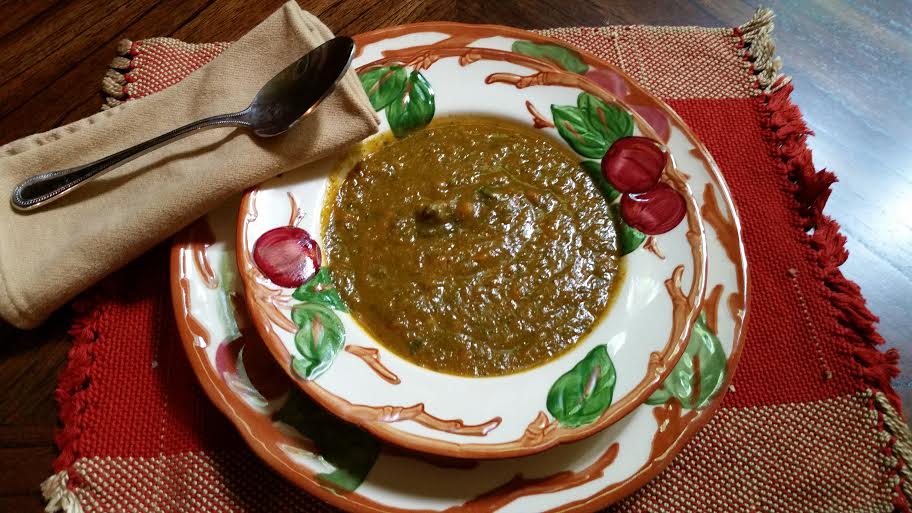
I know it’s still August and still very warm throughout most of the country, but we have been blessed with evenings in the 50’s and some early pumpkins in the Farmer’s Market. So, for supper tonight we had this lovely autumn soup. Make it in the late morning or the night before and let the flavors meld. Then reheat and serve with crusty bread. This is quite spicy. Omit the crushed red pepper for a milder soup. ~ Glyn
1 medium carrot, finely chopped
2 stalks celery finely chopped
1/2 medium onion finely chopped
1 tbsp. garlic, minced
2 tbsp olive oil
6 plum tomato, diced
2 cups chicken stock
3 cups pumpkin (baked and cooled) 1/2 tsp salt
1/4 tsp crushed red pepper
1/2 tsp cinnamon
1/2 tsp curry powder
1/2 -1 tsp garam masala
1/2 – 1 tsp cumin
1/2- 1 tsp baharat spice
1 cup plain yogurt
Procedure
1 Saute the onion, garlic, celery and carrot in the olive oil.
2 Add the tomatoes and saute.
3 Add the chicken stock and pumpkin. Mix well.
4 Add the spices and bring to a bubble.
5 Simmer for one hour.
6 Let sit at room temperature until ready to serve,
7 Reheat and stir in the yogurt.
8 Serve at once.
Servings: 8
Yield: 12 cups
Degree of Difficulty: Moderately difficult
Preparation Time: 30 minutes
Cooking Time: 1 hour
Inactive Time: 3 hours
Total Time: 4 hours and 30 minutes
Nutrition Facts

Serving size: 1/8 of a recipe (11.1 ounces).
Recipe Type
Soups
Healthy Breakfast Muffins
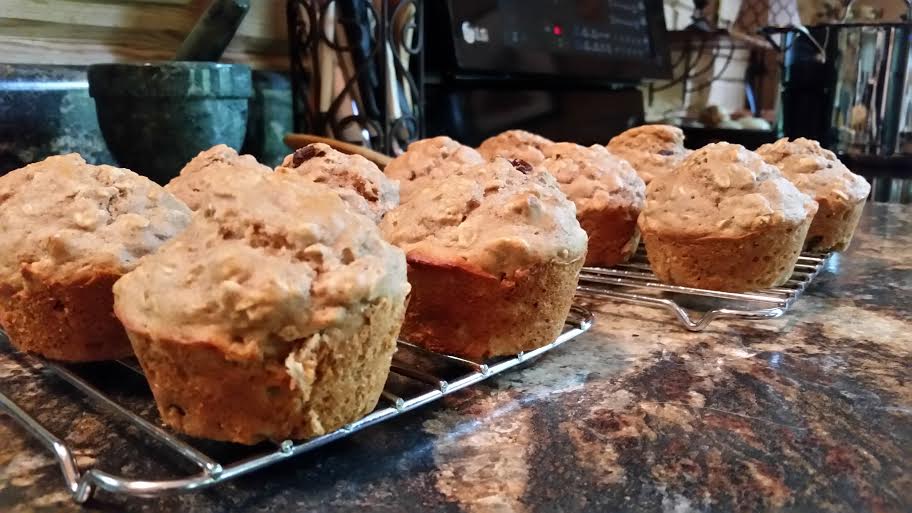
Quick, Easy and Healthy, too! Use organic products and it’s even better.
1 cup all-purpose flour
1 cup whole wheat flour
1 1/2 cups oats
1 tbsp baking powder
1/2 tsp. salt
1/2 tsp. cardamom 1/2 tsp cinnamon
1/4 tsp nutmeg
1/4 cup honey
1/4 cup vegetable oil
2 large eggs
1 cup soy milk
Procedure
1 Combine all dry ingredients in a large bow. Stir to mix thoroughly.
2 Beat the eggs with a fork.
3 Add the milk, oil and honey to the eggs.
4 Add the liquid ingredients to the dry ingredients. Stir to mix but do not beat.
5 Pour into prepared muffin tin or paper muffin cups.
6 Bake in pre-heated 375 degree oven for 15-18 minutes.
7 Remove from the pan and cool on racks.
Servings: 12
Yield: 12 Muffins
Degree of Difficulty: Easy
Oven Temperature: 375°F
Preparation Time: 10 minutes
Cooking Time: 15 minutes
Total Time: 25 minutes
Nutrition Facts

Serving size: 1/12 of a recipe (3.1 ounces).
Recipe Type
Bread, Breakfast
Introducing “Go Make Disciples”
Our first full line of liturgical season stoles is named for the motto of the School of Theology. Designed and woven by Glyn, these stoles will see you through an entire year of services and are versatile enough for everyday or festive occasions. They measure approximately 5.5″ x 8’each and are made of 100% mercerized cotton. Although colorfast, we recommend dry cleaning as needed.
Prices: $125.00 each or $500.00 for the set of five.
Contact Glyn at g.ruppemelnyk2015@gmail.com or by phone at 610-257-6813 for more information or to order.
New designs coming up shortly, so stay tuned.
For Advent

Detail

For Christmas and Easter

Detail
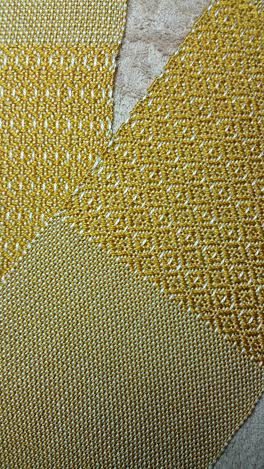
For Epiphany and Ordinary Time
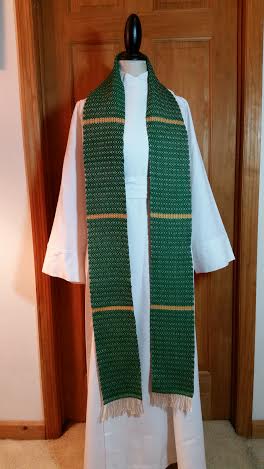
Detail
For Lent

Detail
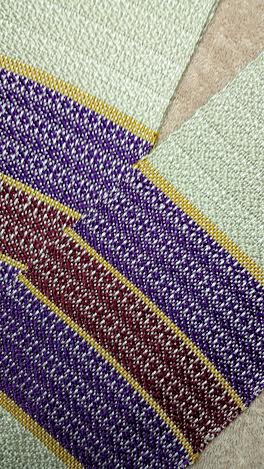
For Pentecost, Saints and Martyrs

Detail

Daily Bread
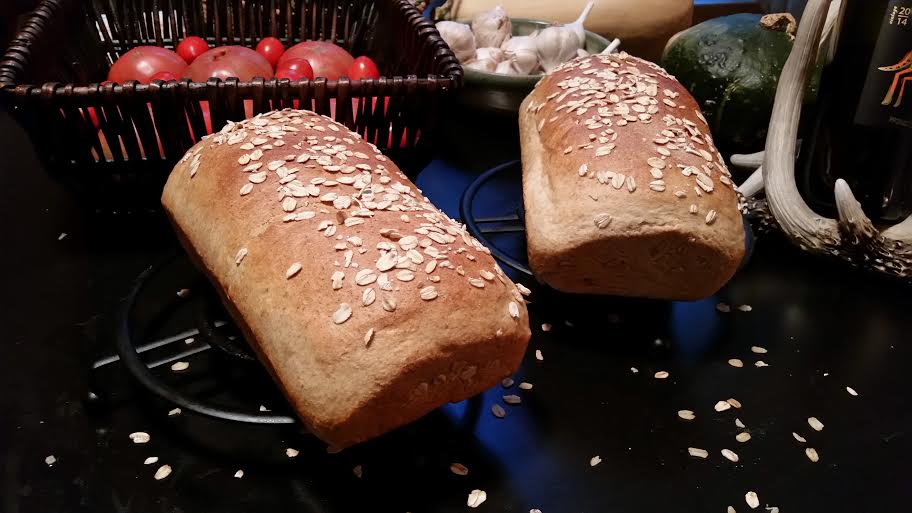
Whole Grain Bread
One of the things I heard most often when I was in active ministry was: “I just don’t have time to do the things that I want to do!” I know this is true, because I often thought it myself. Though, if truth be told, I usually found a way to do the things I really wanted to do! But, life today does not leave us much time to call our own, and what little there is can be quickly overwhelmed by the list of things that we have already put off. And all too often, the first thing to be set aside is the opportunity for spiritual growth and for prayer. We will get to it later, we think. Perhaps before bed. At which point we will no doubt collapse before the first “Dear God” is formed in your thoughts. But the fact is that if we do not take the time, we will never have it. And for nearly all of us, there really is time. The problem is that there are things that we think we have to do which we really don’t have to do at all.
So this meditation will give you permission to choose to take one thing off your to-do list and to replace it with something that will feed your soul and your body – as well as your family. You can even combine a couple of things into one activity. In this instance, Prayer and Bible Study along with baking bread. It’s a form of active prayer, and the rewards are tangible!
The recipe is simple, direct, and physically engaging. It’s the bread I make for daily use in our home. The list of ingredients can be found in any supermarket if you don’t already have them on your shelf.
Once you know that you have everything on hand, take a look at the ingredients in terms of Scripture passages. Read these verses and the thoughts which accompany them. Then, as you bake the bread, especially as you handle the ingredients and knead the dough, think about the meaning of the Bible verses you have just read. Let the Spirit speak to you as you work. And if prayers arise in your mind, offer them to God and ask for guidance in your life. But most of all, approach this moment with an open and grateful heart.
Daily Bread: From Dayenu
Physical Ingredients:
1 cup warm (not hot) water
1 envelope active dry yeast
2 large eggs + 1 egg white for a wash
2 tbsp. brown sugar
¼ cup olive oil
1 tsp salt (or more to taste)
2 ½-3 cups organic unbleached flour
1 cup organic whole wheat flour
1 cup organic whole grain dark rye flour
¼ cup oatmeal.
Spiritual Ingredients:
Water ~ Genesis 21:17-19 And God heard the voice of the boy; and the angel of God called to Hagar from heaven, and said to her, ‘What troubles you, Hagar? Do not be afraid; for God has heard the voice of the boy where he is. Come, lift up the boy and hold him fast with your hand, for I will make a great nation of him.’ Then God opened her eyes, and she saw a well of water. She went, and filled the skin with water, and gave the boy a drink. (God provides for the most basic of our needs. May our eyes be opened to see the blessings all around us.)
Leavening (eggs and yeast) ~ Leviticus 23:17 You shall bring from your settlements two loaves of bread as an elevation-offering, each made of two-tenths of an ephah; they shall be of choice flour, baked with leaven, as first fruits to the LORD. (When we raise our hearts in prayer and devote our hands to creative work, we are making an offering of ourselves.)
Oil and Honey ~ Deuteronomy 8:8 God will bring you to a land of wheat and barley, of vines and fig trees and pomegranates, a land of olive trees and honey. (The richness of creation surrounds us, and is a reminder that the loving kindness of God is abundant. Take note of the abundance in your life.)
Salt ~ Leviticus 2:13 You shall not omit from your grain-offerings the salt of the covenant with your God; with all your offerings you shall offer salt. (Salt is as necessary to our lives as is water. Without it, we die. Be a salty person who knows and lives in covenant with God.)
Grain and Flour ~ Genesis 18:6 And Abraham hastened into the tent to Sarah, and said, ‘Make ready quickly three measures of choice flour, knead it, and make cakes.’ (Abraham and Sarah offer to God the first fruits of their shared life. Are you willing to offer the choicest parts of yourself?)
Procedure:
Dissolve the yeast in the warm water.
In mixing bowl, beat the eggs and sugar together with a fork.
Stir in the salt and the olive oil.
Add the yeast and the water.
Add the whole wheat flour, the rye flour and 2 cups of the white flour, stirring with a wooden spoon to make a soft dough.
Turn out onto a floured surface and work in the remaining flour as needed to make a moderately stiff dough.
Knead for up to ten minutes until smooth and elastic.
Place in an oiled bowl and turn to cover both sides with the oil.
Cover with a tea towel and let rise in a sheltered place (a cold oven works, and an oven with a “proof” function is perfect) and let rise until doubled or about one hour.
Punch down, shape and place into greased bread pans or shape freeform on a parchment paper lined baking sheet (or on a lightly greased baking sheet.
Brush with an egg-wash made of 1 egg white and 1 tsp water. Sprinkle with oatmeal.
Let rise again.
Bake at 375 for 30 minutes or until the loaves are nicely browned and sound hollow when tapped.
Cool on racks.
This will keep well for several days. But if you’re not going to eat it all by then, freeze it.
Dayenu,
Glyn
Rock Of Ages

But you are always the same, and your years will never end. (PS 102:27)
For the Psalmist, struggling with his own mortality, this word about the nature of God is extremely good news. He knows that no matter no happens to him in his life, or the lives of his descendants, God is the one, eternal constant.
Odd, isn’t it, that we don’t quite share his confidence? We know that our lives change – all the time – and that our tried and true methods of understanding and coping with that change do not always work. This is especially true when we have mistaken our static processes and opinions for the constancy of God. Put another way, we get into trouble when we forget that while God does not change, our relationship with God must and does change.
There was a time in my childhood in which I believed that God only heard my prayers when I got into bed, closed my eyes, and turned my face toward a specific corner of the room. As things go, that was probably a good way of disciplining myself to approach God with regular intention. But if that were the only manner in which I pray today, how could I be in prayerful relationship with the Holy One when the need and desire for prayer arises while I am driving, or kneading bread, or working at my loom?
God has not changed. But I have. And the level of comfort I derive from knowing that God is always and eternally present is beyond any sense of peace or presence that I might know if I were I to limit my prayers to those times when I am the right place with the correct posture and the appropriately focused attention. This does not mean that I no longer say my prayers in bed at night; it simply means that my beginning and end-of-the-day prayers are more like the start and finish my daily dialogue with my Maker.
We can learn a lot from the trust and confidence of the Psalmist. He knew where to find and how to access the anchor of his daily and spiritual life. May we learn to do so as well.
Dayenu,
Glyn
Lamb Stuffed Poblanos with Tomatillo Sauce (serves 4 as a main course)
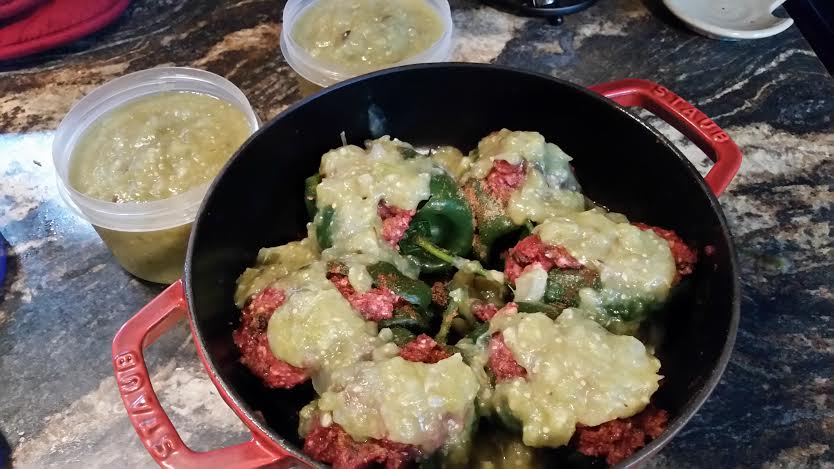
Ready for the Oven
As promised, here is a meal featuring produce from this week’s trip to the Farmer’s Market. This one is destined to become one of our go-to party dishes. It’s gorgeous, and it’s surprisingly easy. Just be sure to use a deep pan for roasting the poblanos…unless of course you don’t mind cleaning the spills from your oven floor! ~ Glyn
For the Poblano Sauce: (makes at least a quart)
24 large (Gulliver) tomatillos, shucked and rinsed
1 lb white onions, peeled and thickly sliced
1 head of elephant garlic (about 8-10 cloves) peeled and halved
1 tbsp. vegetable oil
Drizzle of olive oil.
Use your hands to rub the vegetable oil onto the surface of the tomatillos. Place them in a deep, foil-lined baking dish. Scatter the onion and garlic around them. Drizzle a bit of olive oil over the onion and garlic. Bake at 400 for one hour, turning the tomatillos over at the halfway point. CAREFULLY remove from the oven and let cool to warm. With a slotted spoon transfer the solids to a blender and process just until thick and slushy. Refrigerate for use in sauces or salsas.

For the Poblanos
8 medium size poblanos, blanched
1 lb. ground lamb
2 eggs
½ cup raisins
½ cup coarsely chopped walnuts
¼ tsp garlic powder
¼ tsp onion powder
1 tsp Baharat spice
½ to 1 tsp cumin
Salt and pepper to taste.
Carefully make a cut down one side of each poblano but do not force them open. Blanch in boiling water for 3 minutes.
Rinse in cool water.
Gently open each pepper along the slit you have made and carefully remove the seeds.
Drain the peppers on paper towels.
Combine the remaining ingredients in a bowl and mix thoroughly.
Divide the meat mixture into eight portions and gently stuff the peppers.
Arrange the peppers in a non-stick baking dish.
Top with 1 cup of the tomatillo sauce (or to taste).
Sprinkle with additional cumin and bake, uncovered for 45 minutes at 350 or until the filling is cooked through, adding additional sauce if things begin to dry out.
Serve with a crisp green salad or some homemade guacamole and you’re good to go!
Hummingbird Ethics

eternal vigilance
Back in May we noticed that a hummingbird visited our front garden several times each day. In order to make it welcome we put out a feeder. And it hopes of attracting more hummingbirds, we added additional feeders to the yard. What we did not realize was that the one bird would consider himself lord and master of the entire yard and would spend all his time guarding all the feeders. Naive as we are, we thought that the abundance of food might make him a bit more tolerant of other birds. We were wrong. Later, he did mate, and albeit grudgingly, permits her to feed as well.
Lately, another pair of hummingbirds have been showing up — no doubt because it is nearly time for their annual migration south and they are bulking up for the journey. But because of the aggressively territorial nature of the first set of birds, I doubt that any of them are benefiting from the calories they snatch between bouts of aerial warfare. More than enough food for dozens of hummingbirds with four birds fighting over it all!
Which perturbs me no end as it reminds me of how similar we human creatures are. There is more than enough food on this planet to feed us all. There is more than enough intelligence, resources and technology to end poverty. Literacy and education are no longer optional, they are necessary to the success in life. But what do we do? We continue to embrace the false and self-destructive notion that there is not enough to go around. We hoard, and in doing so, create even more fear and conflict. We squander our own energy in trying to prevent others from accessing what they require in order to become part of a productive whole.
If we don’t wake up soon, this “zero-sum game” mentality will be the death of us. And if the human race were to have a collective obituary, it might read, “cause of death: stupidity.”
Here’s a thought for the day: Even if for no reason other than enlightened self-interest, let’s all share something. Just give it a try.
Dayenu,
Glyn
Middle Eastern Beef with Shitakes

Today is Tuesday, so during the time we would normally be cooking, we’re off to the local Farmer’s Market to pick up this week’s order. We make two stops each week, first to Mooney’s Emporium to pick up from Michael Raines’ Frontier Family Farms, and then to the Sewanee Community Center for the South Cumberland Farmer’s Market (now known as Rooted Here).
Since we will be out this afternoon, I put supper on the stove a bit earlier to simmer. With the exception of some dried spices and the olive oil I purchased from Mooney’s last month, this meal is made entirely of ingredients available either from local farmers or from my own herb garden.
Wherever you live, look for CSAs and for local farmer’s. Buy what you can, and freeze or preserve it so that you can enjoy the fresh tastes and nutrition of local sustainable agriculture year-round.
Good Cooking my Friends!
Dayenu, Glyn
Middle Eastern Beef with Shitake Mushrooms (serves 4)
2 tbsp. olive oil
1 lb. lean ground beef (shaped into 8 lozenge shaped pieces)
1/4 lb. shitake mushrooms, sliced
1 medium yellow onion, halved and sliced
3 large cloves garlic
6 small tomatoes, quartered
1/4 cup fresh basil leaves
1/2 tsp ground sumac berries
1/2- 1 tsp. baharat spice
salt and pepper to taste
1/4 c toasted pine nuts or 1/2 cup walnut pieces
In the olive oil, saute the mushrooms, onions and garlic until just golden. Add the beef and cook at medium heat until lightly browned on both sides. Add the tomatoes, spices and basil. Stir to combine. Reduce heat to a bare simmer, cover and let cook until you are ready to eat. If your stove will do a very low simmer, you can leave this or an hour or two. If not, put the covered pan in your oven and cook it at 200 F.
Serve with a simple chopped salad made of tomatoes, green onion tops, and cucumbers dressed with white balsamic vinegar.
Then get to work sorting and cooking your haul from the Farmer’s Market.

Breathe on me breath of God

Yesterday the rains finally Arrived. The first few weeks of August had been hot and still. The stifling heat and humidity on the plateau were often overwhelming. Even the birds and insects seemed to move about as little as possible. The mood had been so pronounced that yesterday’s rain felt as though the humidity had finally tired of holding itself in suspension in the air and was simply falling to the ground.
Today’s rain is different. It carries a sense of purpose. It falls with force and intention, alternately rinsing the dust from the ground, and washing the lingering mist from the air. It’s wonderful. In fact, there is even something glorious about it. Because along with the moisture and the coolness, there is a breeze…a breeze that is so gentle and yet so insistent as to be soul-renewing. It reminds that the doldrums are not permanent, and promises that autumn will come. We are not trapped forever in the incapacitating heat of August.
How often our spirits feel that way! Stuck, barely aware of our surroundings, and moving only when absolutely necessary. Until the breath of God stirs and awakens us from our torpor. In those moments we feel alive again. We become aware of hope that has evaded us and possibilities which seem to have been too weighty to engage us. It is as though the breath of God, like rain, washes us clean and fills to overflowing the recently stagnant cisterns of our souls.
May you know the power of the waters of life this day. May you feel the renewed strength of hope and purpose. May your thirst be quenched, your body renewed and you spirit empowered for love.
Dayenu, Glyn
Challah
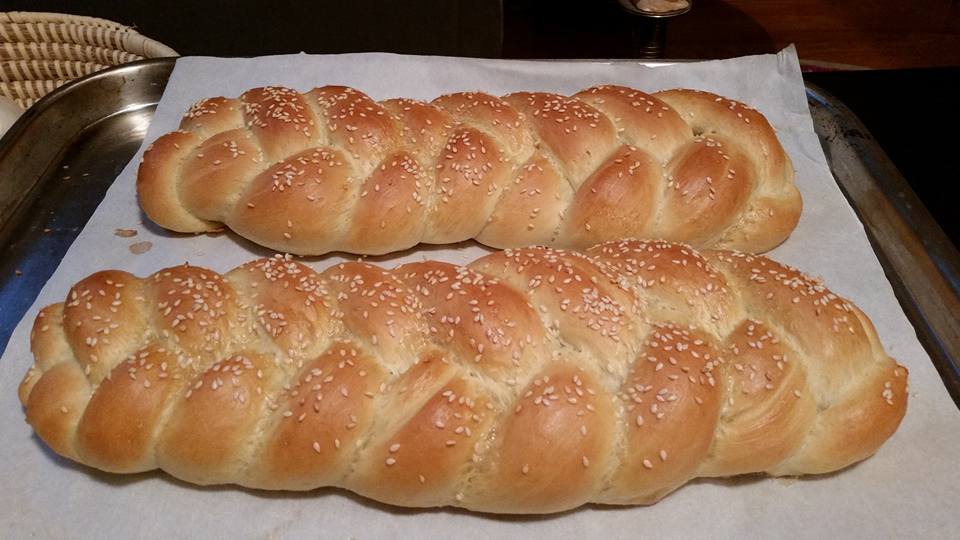
Even though I am gluten-intolerant and only allow myself a taste of this bread once a week at our Sabbath dinner, I love baking it! There is something so soul-satisfying about working with bread dough — the aroma, the textures, the rhythms of kneading, and the patience of waiting for the miracle of the rising. As the Sabbath prayer says, “Blessed are you, O God, sovereign of the universe, for you have given us this bread to sustain our lives.”
This started out as a recipe from Williams Sonoma. It was quite good, but was not quite so yeasty as I prefer, and it made two enormous loaves. So after a bit of tinkering, this is what I use for our weekly batch of Challah. Do not use rapid rise yeast as it tends to make the bread very spongy and flattens the shape of the braids. Dayenu ~ Glyn
~ Glyn
1 tbsp dry active yeast (1 pkg)
1/4 cup water (warm but not hot)
1 tsp salt
1/3 cup sugar or honey (organic)
3 large eggs
4 tbsp butter
3 to 3 1/2 cups flour (organic, unbleached)
1 tsp sesame seeds
Procedure
1 Sprinkle the yeast on the warm water and let sit while you
2 Beat the eggs, sugar, salt and softened butter together (in a large bowl with a fork, not a mixer)
3 Stir in the yeast/water.
4 Add 2 cups of the flour, mixing well with a fork or wooden spoon.
5 Add the remaining flour by quarter cupfuls to make a soft dough.
6 Turn out onto a lightly floured surface and knead for 8-10 minutes, adding additional flour if needed.
7 When the dough is smooth, satiny and elastic, transfer to a lightly oiled bowl.
8 Turn once to get the oil on all sides of the dough.
9 Cover and let rise till doubled (about 90 minutes) in a spot free from drafts. I use proof function in the oven.
10 Shape or braid into two loaves and place on a parchment lined baking sheet. Wash with egg white and sprinkle with sesame seeds.
12 Let rise another 30-45 minutes.
13 Bake at 375 for 20-25 minutes. Watch to keep from getting too brown.
14 Cool on racks.
Servings: 12
Yield: 2 loaves
Degree of Difficulty: Moderately difficult
Oven Temperature: 375°F
Preparation Time: 30 minutes
Cooking Time: 25 minutes
Inactive Time: 2 hours and 15 minutes
Total Time: 3 hours and 10 minutes
Nutrition Facts:

Serving size: 1/12 of a recipe (2.2 ounces).
Recipe Type
Bread
Lamb-Stuffed Zucchini with Canteloupe Sauce
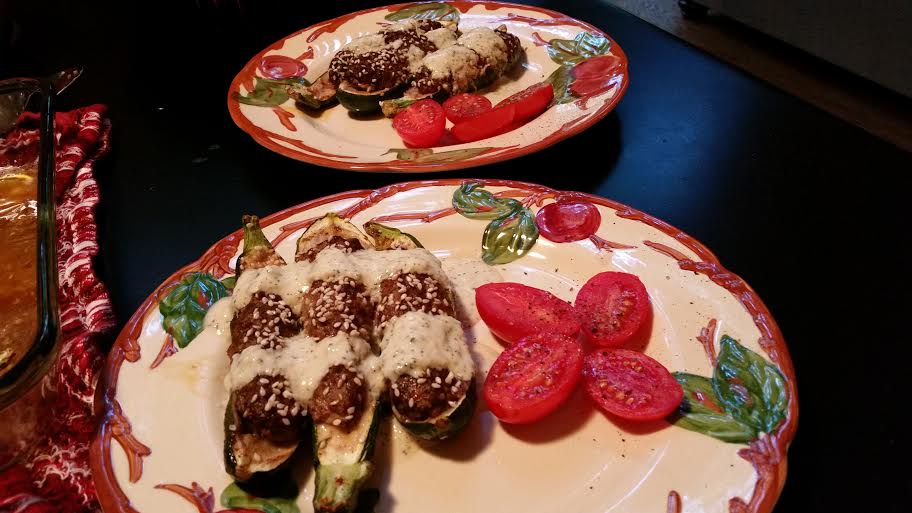
I love to cook. I really do. Perhaps because it reminds me of my mother and grandmother. Perhaps because it is an opportunity to express myself with something that also demonstrates my love for those around me. This recipe is especially meaningful because it includes memories from several parts of my life – the fresh produce of an Appalachian summer, the flavors of the middle east, the hot and sweet coolness of southwestern cooking and the unending question of what to do with all the zucchini your garden produces. So with love to all those things and especially to my mom and grandma, here it is. By the way, this makes plenty of the sauce which is also excellent as a cold soup!
1 lb ground lamb
1/4 lb mushrooms (preferably shitake as they are very moist)
1/2 cup onion chopped
1/2 cup walnut halves (or 1/4 cup pine nuts)
1 tsp chopped garlic
1/2 cup sweet peppers (red, green or yellow)
1 cup chopped seeded tomatoes
1/2 tsp dried basil
1 tsp baharat dried spice or curry powder
6 medium medium zucchini (halved with the center scooped out and added to the lamb) 1 tsp sesame seeds
1/4 tsp Salt and pepper (or to taste)
4 cups cantaloupe (1/2 medium)
2 cups yogurt (whole milk, plain greek)
2 tsp dried mint (or 1/4 cup fresh)
2 tbsp basil, chopped (or 1/4 tsp dried)
1 tbsp chopped jalapeno peppers, or to taste
1 tsp sugar
Procedure
For the Lamb
1 Halve the zucchini and scoop the centers into a bowl. Set the zucchini shells aside.
2 In a food processor, finely chop the mushrooms, onion, garlic, walnuts and tomatoes.
3 Combine the lamb, chopped vegetables, zuchinni centers and spices in a large bowl. Using your hands, combine well.
4 Form the mixture into logs and press into the zucchini halves. Place in a lightly oiled baking dish.
5 Sprinkle with the sesame seed.
6 Bake at 350 for 35-40 minutes or until the meat is done and the zucchini is crisp tender.
7 Serve with the canteloupe sauce
For the Sauce
1 Combine the canteloupe, yogurt, mint, jalapeno and basil and sugar in a food processor or blender. Mix until thoroughly combined. Chill for several hours to allow the flavors to meld.
Servings: 6
Degree of Difficulty: Moderately difficult
Oven Temperature: 350°F
Preparation Time: 20 minutes
Cooking Time: 35 minutes
Total Time: 55 minutes
What Shall I Say?
I’ve been a writer all my life…or at least a talker. I’ve been a teacher, a therapist, a preacher, and lately, someone who observes and comments on life in general. But I’ve always known my audience and have been able to see and respond to nearly immediate feedback. Blogging is quite different. The thoughts and words are put into a bottle and cast out upon the waters. Perhaps they will be received and read. Perhaps they will simply rock upon the ether waves of the internet. Who knows? So, in the past few months as I have settled into the private life of retirement, I have been experiencing a peculiar form of writer’s block. I find that I no longer know exactly what to write about. Without a syllabus or a Lectionary to impose the subject matter, I am adrift in an ocean of possible topics but unable to decide upon which one will serve as my raft for next stage of the journey.
If you are reading this, you most likely know me and read what I write. Hence this invitation. What, if anything, would you like to hear from me? I would love to hear from you, even if your message is “Enough already. Be Quiet!”
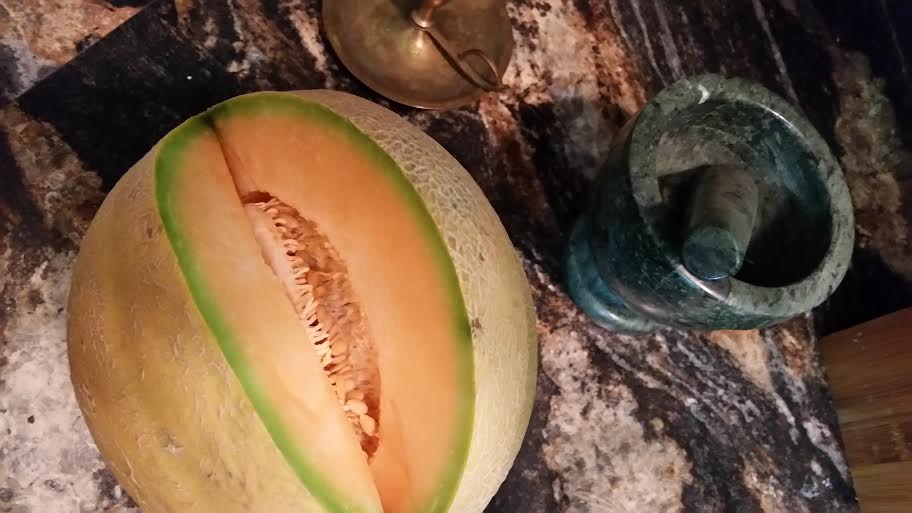
BTW, the cantaloupe was more than breakfast today. It struck me as a metaphor for the process of writing. The tender flesh and fragrance of life are only accessible when its pebbled surface is penetrated by an object capable of breaking through the rind without destroying the essence of what lies within.
Dayenu, Glyn
Pesto ~ Presto!
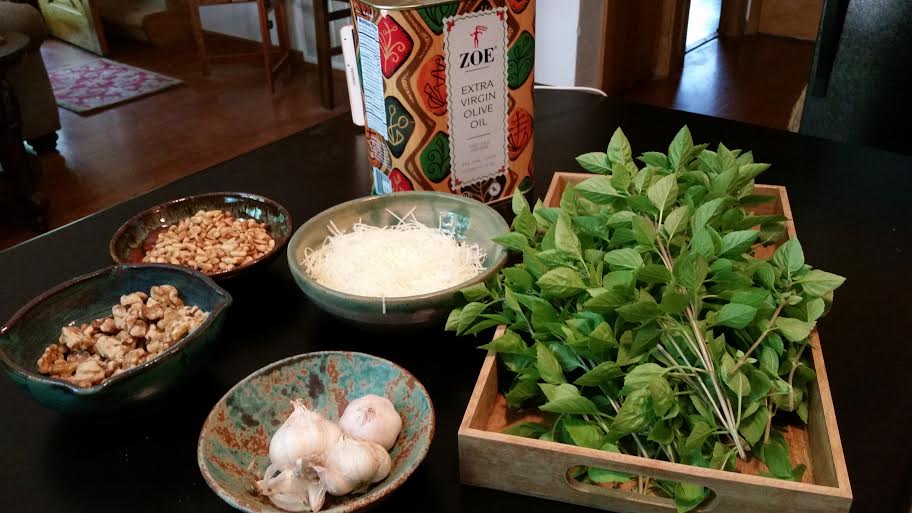
Today is the feast of Lammas, or Lughnasadh as the Celts call it. It’s a celebration of the grain/corn/wheat harvest and it’s traditional to make and eat bread. But for those of us who are celiac or even gluten-intolerant it’s a kind of a sad feast day. Sure there are gluten-free breads and pastas available, but tasty as they may be, they are no substitute for the real thing. Besides, what they lack in texture and mouth appeal, the more than make up for in added sugar. And by the way, please don’t suggest that gluten-intolerance is a fad or affection. If the presence of gluten in your diet gives you gastric distress and keeps you tethered to the nearest “rest-room”, you’re gluten intolerant. So, unless you really like munching ono a rice cake while everyone else is chowing down on homemade bread and pasta, you’re out of luck.
But I’m not one to let a good feast day go to waste, so here at Dayenu (as we formerly did at RavenOak) Will and I will be celebrating the harvest with the freshest, tastiest, gluten-free meal we can produce. Dinner tonight will feature and arugula salad, shrimp pesto served with polenta, and for dessert, blueberry crumble. All of which is gluten-free, added sugar-free and low carb. Did (I mention that my metabolism doesn’t like sugar either?) These recipes are amazingly simple and the pesto makes enough for tonight, PLUS two dozen 1/4 cup “cubes” to freeze for the winter when basil is not available. Yes, it’s a bit pricey to make up-front, but when you divide the cost by 25, it’s a real bargain…not mention that you’ll be able to enjoy the taste of midsummer all winter long.
Dayenu, Glyn
Now for the recipes:
Pesto:
4 oz. pine nuts (toasted in a dry skillet till golden brown)
4 oz. walnuts
2 c FIRMLY packed fresh basil leaves
1 tbsp. (heaping) minced garlic
2 c. freshly shredded parmesan cheese
1 c. extra virgin olive oil
In a food processor, chop the nuts till fine but not pulverized. Transfer to bowl.
Combine the garlic and the basil and process till finely chopped.
Add the nuts, cheese and olive oil to the basil and garlic and pulse until smooth.
Spoon into ice cube trays or small muffin cups and freeze. Transfer to freezer bags for long term storage. To use, simply thaw and heat, seasoning to taste.
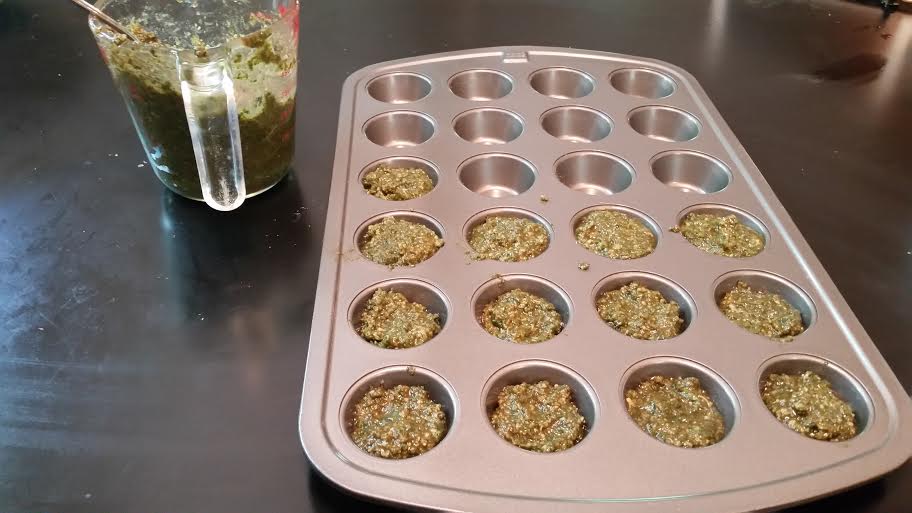
Blueberry Crumble
1 quart fresh blueberries
1/4 c Splenda (divided)
2 tbsp butter or margarine
1/2 c almond meal (ground almonds)
1/2 c oatmeal
Cinnamon, Cardamom and Nutmeg
Place the washed, drained berries in a baking dish. Sprinkle with half of the Splenda and with the spices to taste. Combine the butter, almond meal and oatmeal and mix with your fingers to make a crumbly topping. Spoon over the berries. Sprinkle on additional spices to taste. Bake at 375 for 45 minutes or until the topping is nicely browned and the berries are bubbling. Cool. Serve warm or at room temperature.
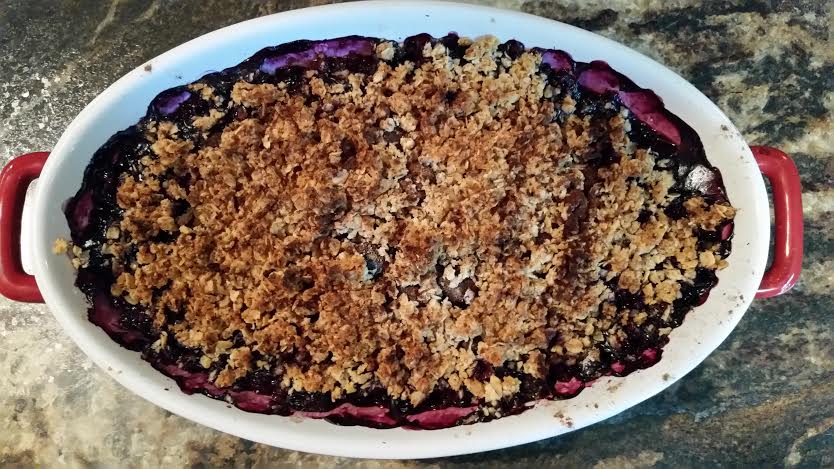
–
Once in a Blue Moon Summer Tart: It’s Summer-Full (But Gluten and Sugar-Free!)
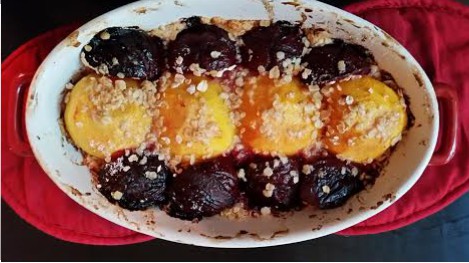
Today is July 31st and the moon is full for the second time this month, which makes it a “blue-moon”. Not only that, but the night-time temperatures dipped into the low 60’s here on the Cumberland Plateau last night – two reasons for a celebration.
So here is a dessert to mark the occasion. It’s gluten-free and has no sugar other than what occurs naturally in the fruit. And if you use a non-dairy substitute for the butter, it’s even Vegan! Make this for your family and enjoy it plain, with cream, or with ice cream.
Dayenu,
Glyn
Once in a Blue Moon Summer Tart
1 ½ cups ground almond flour
¼ c Splenda or sugar (or equivalent amount of Truvia)
¼ c butter or vegan margarine (softened)
Dash of salt
2 freestone peaches, halved and peeled
2 red or black plums, seeded and quartered
1 tsp Splenda
1 tbsp oatmeal
Reserve 1 tsp of the butter to dot on top of the tart before baking. Combine the almond meal/flour with the butter and the sweetener. Mix thoroughly with your fingertips and press firmly into a shallow baking dish or pie pan.
Arrange the cut fruit over the crust, sprinkle with the remaining sweetener and the oatmeal. Dot the tops of the fruit with the butter.
Bake at 375 for up to one hour, or until the fruit is cooked and bubbly and the crust is lightly browned. Let cool to room temperature before serving.
In All Times and Places, Give Thanks
We bless you, God of Seed and Harvest, and we bless each other
That the beauty of this world, nd the love that created it
Might be expressed though our lives nd be a blessing to others
Now and always. AMEN (From Praying Through the Celtic Year)

Every culture and every faith has harvest celebrations.
While we here in the US are most acquainted with such festivals in autumn, those of us with Celtic backgrounds may know about a cycle of eight such events — one of which occurs about every six weeks. These “holy days” are ancient in origin and are often solar or lunar observances, but that’s not all…they are so universal that by the middle ages, they had even been incorporated into the calendars of the church. August 1st became known as Lammas and was a bread-festival.
This weekend marks one of those events. Variously known as Lammas, Lughnasadh, Bread Harvest, First Harvest, or even Freyfaxi, August 1st marks the grain, corn, or summer harvest. But depending on where you live, this day in high summer (or mid-winter for those who live down-under) may also be the time when you find yourself surrounded by tomatoes, squash, onions, zucchini and fresh herbs as we are here on the Cumberland Plateau in Tennessee. In a few days I will be making and freezing a big batch of pesto with the Greek Basil from my own herb garden, but today I am making tomato sauce.
We moved here a bit too late this year to get our own tomatoes going, but fortunately, I have found a source for buying very meaty Roma tomatoes in bulk (White City Produce and Greenhouse https://www.facebook.com/whitecityp.g) and the first batch is already simmering on the stove. Redolent of herbs and spices, it smells heavenly…which brings me to my real point for writing this. How often do we give thanks for the simple pleasures of our lives?
The scent of a ripe tomato (and its pungent vine) is an occasion for gratitude. The lingering aroma of garlic and onions on your fingers after chopping is a reminder of how much you have for which to be thankful. Even the grit on your countertops and under your fingernails when you sort produce or rinse fresh greens is an opportunity to give thanks for all that this good earth produces.
So, whatever your tradition may be, now is a good time to look around at the bounty of your life and mark this time of year with a special act of gratitude for all your blessings. Make a gift to a food bank, prepare a special meal using the fruits of this summer harvest, or just stand outside and breathe a prayer of thanksgiving.
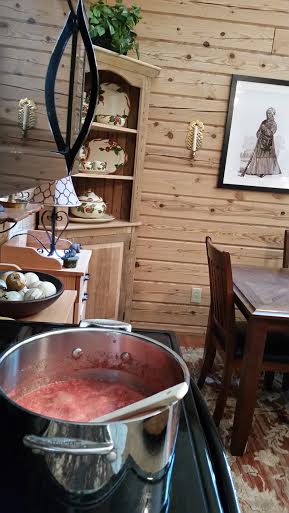
And here is the recipe. No, it’s not for bread, but some fresh rosemary focaccia would be perfect with it.
Glyn’s Lammastide Tomato Sauce
5 lbs roma tomatoes, stems removed and cut into quarters
2 large onions, finely chopped
6 medium garlic cloves, minced
1/4 c olive oil
1-2 tsp salt
1 tsp ground black pepper
1 c chopped fresh basil (or 1 tbsp dried)
1/4 c chopped fresh oregano (or 1 tsp dried)
3 bay leaves
In batches in a food processor, pulse the tomatoes until chopped or pureed. Meanwhile, saute the garlic and onion in the olive oil until translucent. Combine in a large pot with the tomatoes and remaining ingredients and bring to a boil. Lower the heat and cook at a slow boil until the sauce is reduced to the consistency you prefer. Adjust the seasoning. Preserve as you wish. I freeze the sauce in quart size plastic bags. Depending upon how thick you like your sauce, this recipe will make up to four quarts. Dayenu! Glyn
Ratatouille
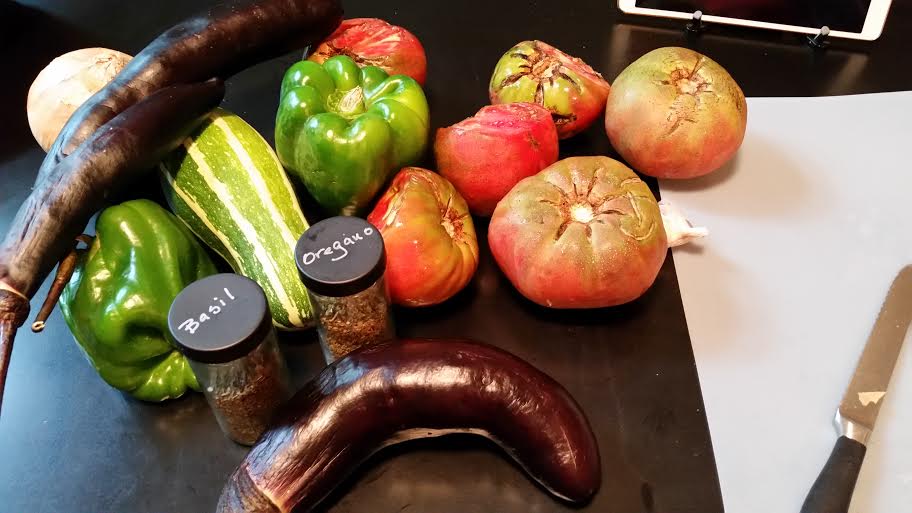
Eating Healthy is sometimes a challenge these days. We think it costs more and takes more time, but if you can connect with a good farmer’s market and dedicate one morning a week to cooking and freezing the results, you will be well rewarded…and your body will thank you, too! We are so fortunate to live in a place with great CSA’s and Farmer’s Markets. This recipe is from the Bounty available at this week’s market. It comes together quickly, tastes fabulous and freezes for later. Dayenu, Glyn
“South Cumberland Farmer’s Market Ratatouille”
Recipe and Sources:
2 cups White Onion (large dice) Michael Raines Frontier Family Farm
1 large clove garlic (minced) Helen’s Half Acre
2 large green peppers (1 inch dice) White City Produce
1 lb Japanese Eggplant (1 inch dice) Helen’s Half Acre
1 large zucchini (1 inch dice) Turtle Run Farm
3 large Cherokee heirloom purple tomatoes (diced) White City Produce
1/4 cup olive oil
1/2 tsp each dried oregano and basil or (fresh to taste) from my own herb garden
2 tbsp. red balsamic vinegar
salt and pepper to taste
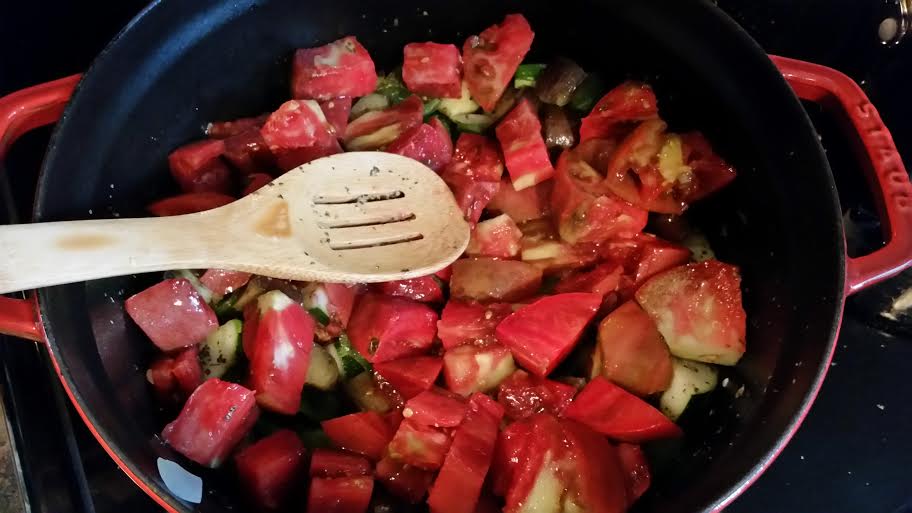
Saute the onion, garlic and peppers in the olive oil until transparent. Add the eggplant and zucchini and continue to saute for 5 minutes. Add the tomatoes, herbs, salt and pepper and simmer until the vegetables are tender and most of the liquid is absorbed. Remove from heat, stir in the vinegar and let cool. Reheat to serve. This will fill four quart-sized freezer bags and freezes well.
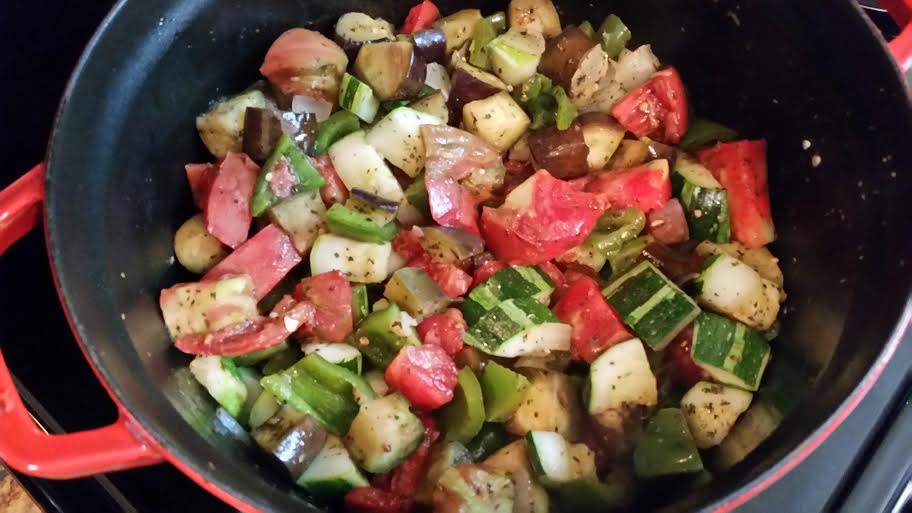
Summer Bounty Roasted Baby Eggplant
The baby eggplant at the Cumberland Farmer’s Market was gorgeous this week and I got three pounds of it. One pound went into the eggplant parmesan we are having for supper tomorrow, but the rest I halved, seasoned with olive oil and herbs and roasted. Most of that batch went into the bags in the freezer to serve as a quick side dish later on the year, but the rest of it will be part of our dinner tonight. This really couldn’t be simpler or tastier. Do try it while the summer produce is fresh and abundant. Arrange these on a pretty platter (this one was a gift from my friend Jane) and serve as an appetizer, first course, or side dish. ~ Dayenu, Glyn
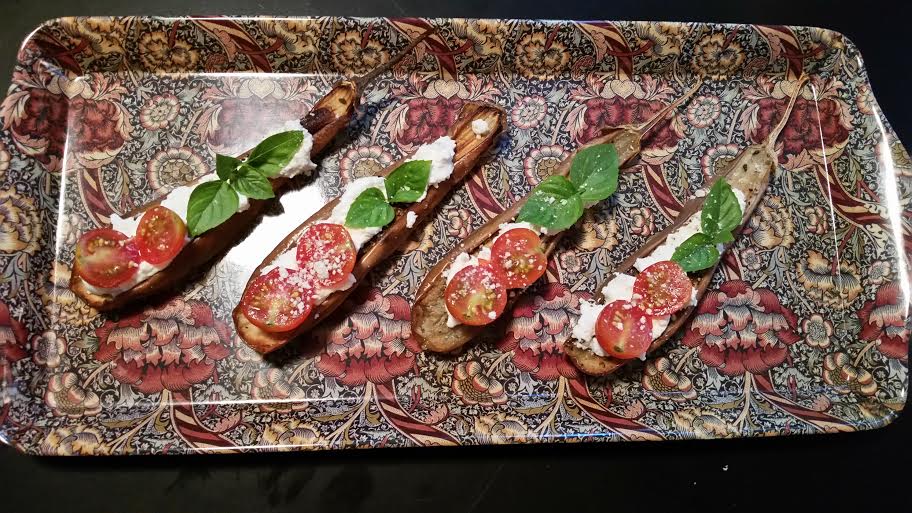
Roasted Baby Eggplant with Ricotta and Basil
1 lb baby eggplant, halved lengthwise (about 8)
1 tbsp extra virgin olive oil
Salt, Pepper
Garlic Powder
Basil and Oregano (dried)
Preheat the oven to 425. Place the halved eggplant in a single layer on a sheet of parchment paper. Brush or rub the cut surface with the olive oil. Sprinkle with the salt, pepper, garlic, basil and oregano. Roast the eggplant until it is quite soft and golden brown. 20 minutes or so, depending on your oven and the size of the eggplant. Let cool to room temperature.
1/4 cup ricotta or vegan substitute
8 grape tomatoes
8 sprigs fresh basil
2 tbsp grated parmesan
When ready to serve, Top each eggplant with a tsp of ricotta, one grape tomato (halved) one sprig of fresh basil and a light sprinkle of grated parmesan cheese. Serve at once, or reheat slowly in a very low oven. Just enough to warm the eggplant, but not enough to make the cheese run.
Mindfulness

Morgan’s Steep Tartan
The finished product of any endeavor is a joy to behold. A symphony, a novel, a new rose garden; a child’s painting, a poem. The finished product I’m looking forward to at the moment is represented at the left – a scarf in one of our Mountain Tartans, “Morgan’s Steep.”
But in weaving, as in all art and most of life, you cannot arrive at the finished product in one quick leap. Indeed, trying to do that is the surest way to a finished product that may not be a joy to behold, that may be marred by mistakes, blemishes, and imperfections.
In weaving, the actual “weaving” part comes at the very end, just before the finished product, and is usually the easiest and shortest step in the process. There are so very many steps that come first – many of them seemingly slow and tedious:
* Create the design
* Choose the weaving pattern
* Pick out the yarns
* Do the math. (Oh, there is so much math! Warp widths, number of yarn “ends,” etc.)
* Prepare the length of the warp yarn on the warping board
* Pull each warp thread through the reed (called “sleying,”) in the proper sequence, one at a time (there may be over 300 of them)
* Go around to the back of the loom and use a heddle hook to pull each yarn end through the proper heddle in the right sequence to produce the weave pattern you have chosen.
* Tie off the warp on the front and back beams.
* Wind some weft yarn on a bobbin and place it in a shuttle, and now you are ready to weave.
* (Well, except for lots of other things I haven’t mentioned here, to save blog space!)
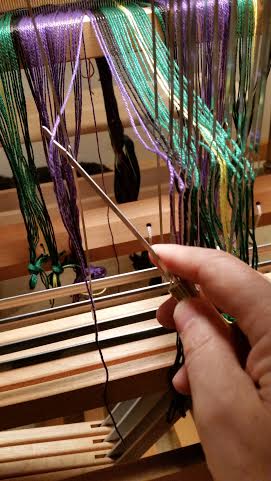
Threading the Heddles
SO, here I am at the heddle-threading stage for my Morgan’s Steep scarf. There are 134 ends, in 4 colors, to thread in the proper sequence to be able to weave an advancing twill pattern, the best to use for producing a tartan.
I’ll be working with 4 shafts (a shaft is a frame that holds the heddles. It moves up and down, in concert with the other 3 shafts, as I step on the treadles – ‘peddles’ – of the loom. This creates different openings in the yarn (called a shed) for me to toss the shuttle back and forth, laying down the weft thread.) So you can see I’ve tied up the loose warp ends in bundles of 12, a multiple of 4. Then using the heddle hook, I begin threading the individual heddles in the proper sequence – this time a simple one: 4-3-2-1, 4-3-2-1, 4-3-2-1, for all 134 threads (or ends.)
This is the slow part. The tedious part. The part where, without mindfulness, things can go terribly wrong. (Believe me! That has already happened twice on this project, requiring a complete starting over.) There is real temptation here. You can see the beautiful sequence of colors you have chosen, and you begin to imagine the finished product. “If I can get through this threading as quickly as possible,” you think to yourself, “I’ll have that beautiful scarf in my hands.” What I really want is the scarf. Not to be threading heddles. And then the mistakes begin to happen.
So near, and yet so far!

Shuttles Lying In Wait
Here is where the mindfulness comes in. Some might call it “patience,” but it is so much more than that. Patience is putting up with what you don’t want, in order to get to that which you do want. Mindfulness, in contrast, is actually wanting to be doing what you are doing at the moment. In this moment, the threading of each individual heddle must be my goal, my “finished product.” The scarf is far in the future, known about, but not filling the mind. To use a theological term (as I am wont to do,) the scarf is an eschatological concept at this point. The shuttle, considered by the uninitiated to be the most important weaving tool, lies by the wayside waiting its turn.
4-3-2-1, 4-3-2-1, 4-3-2-1 . . . black, green, yellow, green, black, purple. The mind is focused not on threading the heddles, but on hooking one specific thread out of 134, and pulling it through the eye of the one specific heddle destined for it. This is my weaving project, right here. The heddle, heddle hook, and purple thread you see in the second picture above. It has to be this way. It has to be this way if that far-off scarf is ever to appear.
This is “Mindfulness,” the greatest lesson a weaver can learn. It is why weaving is a spiritual experience. And if we learn this well enough, we come to see that all living is a spiritual experience. There is a great energy that flows back and forth between the yarn and the mindful weaver. The next time you wear someone’s handwoven “finished product,” open your own mind to it. You will feel that mindfulness, I promise. And it will feel like prayer.
~ Will
“Wandering Jew” Shawl
There are many unfortunate versions in European folklore of the story of the “Wandering Jew.” Most prevalent is that of a Jewish shoemaker who taunted Jesus on His way to the crucifixion, and was condemned by Jesus to wander the world forever, until the Second Coming. It is unfortunately the product of medieval European anti-Semitism. Yet it has its origins in Scripture, in the beloved Confession of the Faith of Abraham in Deuteronomy:
A wandering Aramean was my father,
he went down to Egypt and sojourned there,
he and just a handful of his brothers at first, but soon
they became a great nation, mighty and many.
The Egyptians abused and battered us,
in a cruel and savage slavery.
We cried out to God, the God-of-Our-Fathers:
He listened to our voice, he saw
our destitution, our trouble, our cruel plight.
And God took us out of Egypt
with his strong hand and long arm, terrible and great,
with signs and miracle-wonders.
And he brought us to this place,
gave us this land flowing with milk and honey.
So here I am. (Deuteronomy 26)

So it is not strange that one day someone would give the name “Wandering Jew” to various varieties of spreading ground cover plants. We have one such plant growing beautifully in a hanging basket on our front porch at Dayenu Cottage. In the mornings it captures the light of the rising sun in a glorious burst of purple radiance. As we finished our Mist on the Mountain shawl, it seemed a good idea to switch from a silver weft to a purple weft, and change the weaving design to a more “wandering” twill variation. So on the loom now is the completed “Mist on the Mountain,” and the newly begun “Wandering Jew.” Please contact us for pricing, or for other orders.
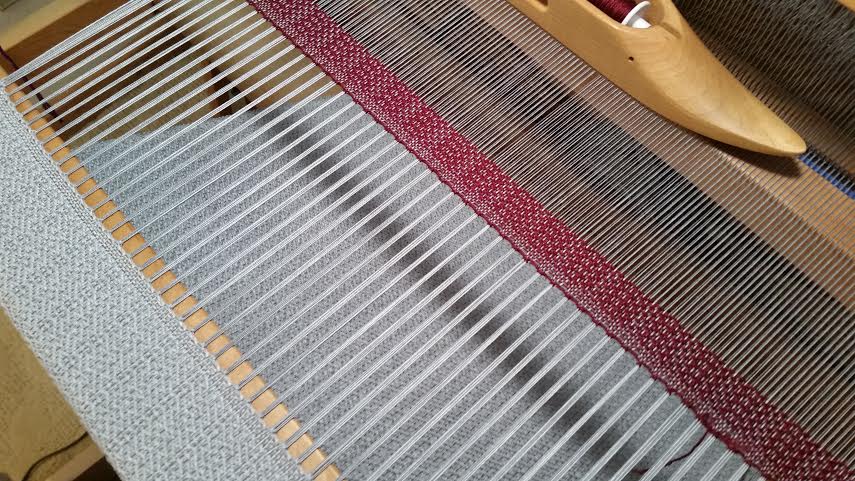
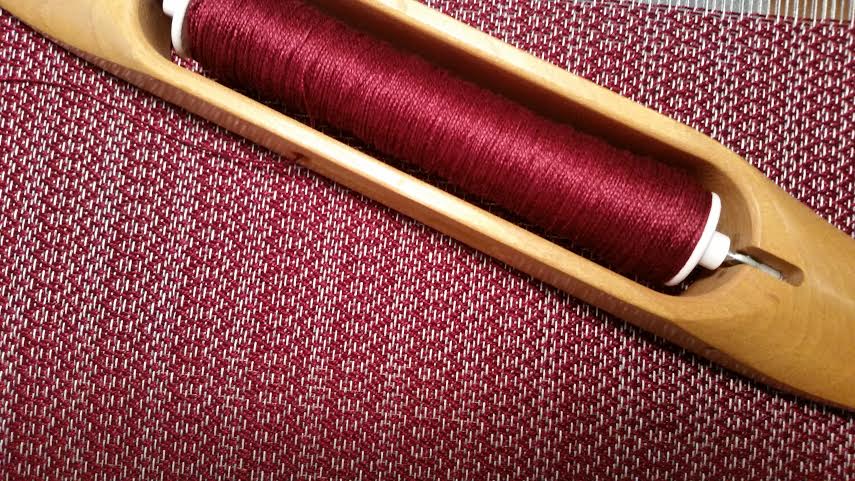
Above: The changeover from “Mist on the Mooutain” to “Wandering Jew,” and the beginnings of “Wandering Jew.”
~ Will
A Wet Week Means a New Weaving Pattern

Around here folks are fond of saying “Fog Happens”. It certainly does, but it is also quite lovely while it’s happening so long as you can either stay home or still see where you’re going. In the winter, the fog freezes on the evergreens, but in the summer, as now, the scene is reminiscent of the primordial wood. So, When it’s too wet to take the canoe out, and the fog comes rolling in, it’s time to take inspiration from your surroundings and design a new pattern. So, we are happy to introduce our latest fabric for shawls, “Fog on the Mountain.”

Inspired by this photo from our front porch, the fabric is on the loom as we speak and 2 shawls are nearly done. They will be 18″ x 66″ and are priced at $175 each. Call or email us for additional information or to place an order. Glyn
Summer Fruit Crumble
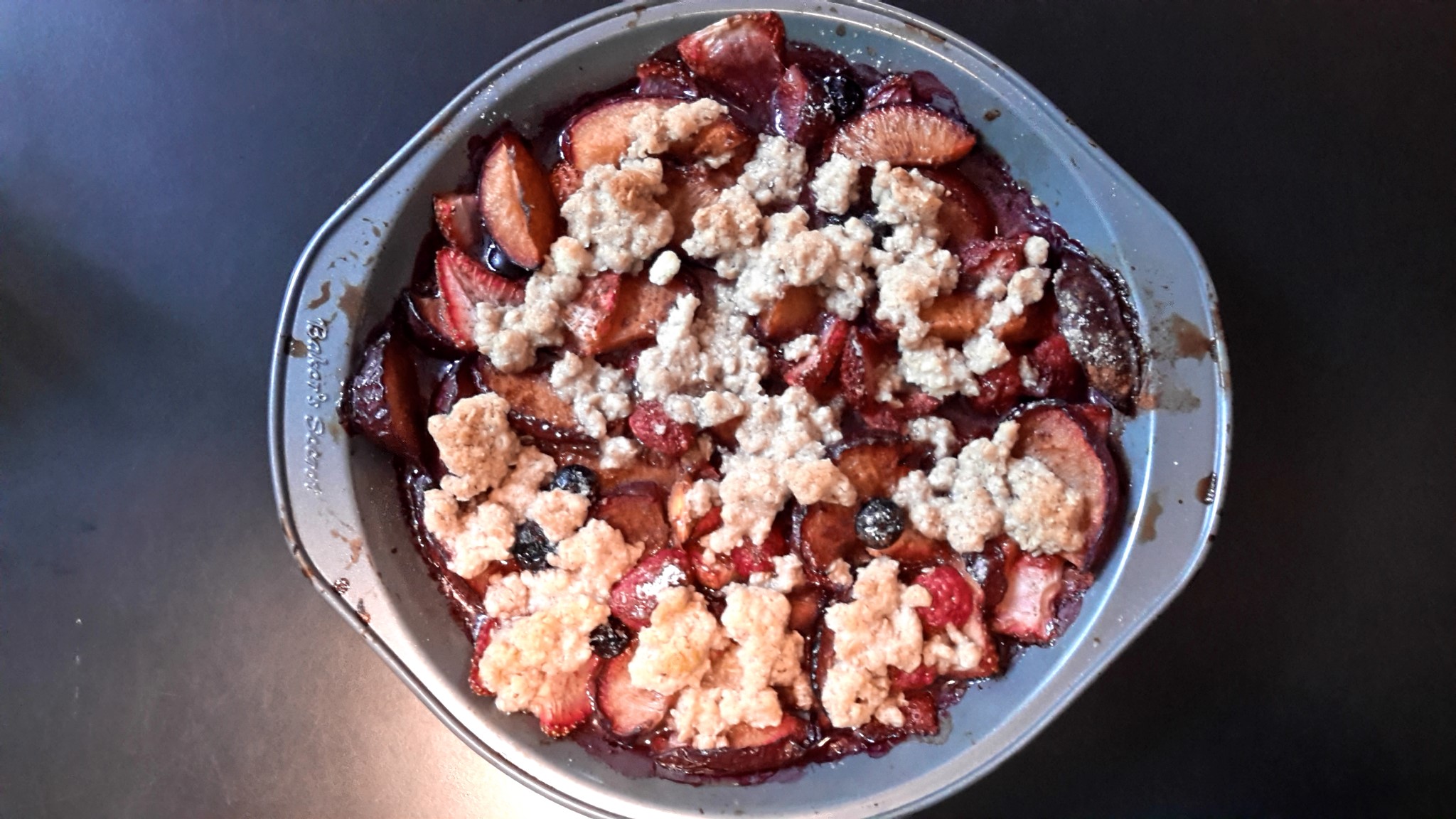
When the local farmer’s markets and CSA’s are brimming with berries and stone fruit, nothing tastes quite so good as a fruit pie, cobbler or crumble. This one is especially tempting because it’s gluten free and has no added sugar. Not to mention that it’s as pretty as a summer day. You can put it together in 15 minutes and cook it earlier in the day to be eaten at room temperature, or just before serving if you want to top it with ice cream. The recipe serves 6 but don’t be surprised if two hungry-types finish it off in one sitting. Doubles, triples, or quadruples easily. Enjoy! Glyn
Ingredients
1 cup sliced sliced plums
4 cups blueberries, sliced strawberries, raspberries, blackberries, or any mixture of berries
1/4 cup Splenda
1/4 cup almond meal
1/4 cup oatmeal
1/4 cup butter or earth Balance Vegan Margarine (melted)
1/2 tsp cardamom
1/2 tsp cinnamon
Procedure
1 Slice the fruit into a nine inch pie pan.
2 Sprinkle with half the cinnamon and half the cardamom.
3 Combine the remaining ingredients to make a moist crumble.
4 Spoon small dollops of the almond crumb topping onto the fruit.
5 Bake in a 375 degree oven for 35 minutes, or until the fruit is juicy and the topping is golden.
6 Serve warm or at room temperature.
Servings: 6
Yield: 1 nine inch pie pan
Degree of Difficulty: Very easy
Oven Temperature: 375°F
Preparation Time: 15 minutes
Cooking Time: 35 minutes
Total Time: 50 minutes
Nutrition Facts
Serving size: 1/6 of a recipe (4.9 ounces)

Recipe Type
Dessert, Gluten-Free, Vegan, Vegetarian
Monteagle Sunset Placemats on the Table
My Monteagle Sunset Placemats are finished and ready for use.
Cotton Yarn, in Plainweave
Designed and Woven by Will Melnyk
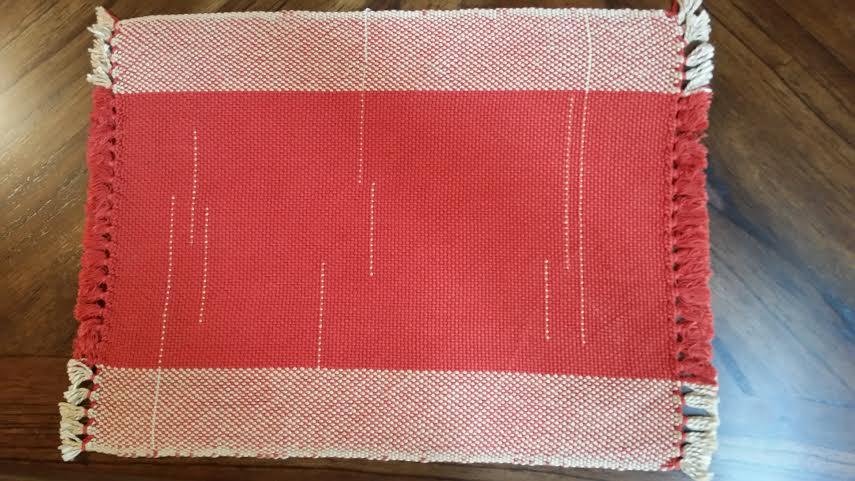
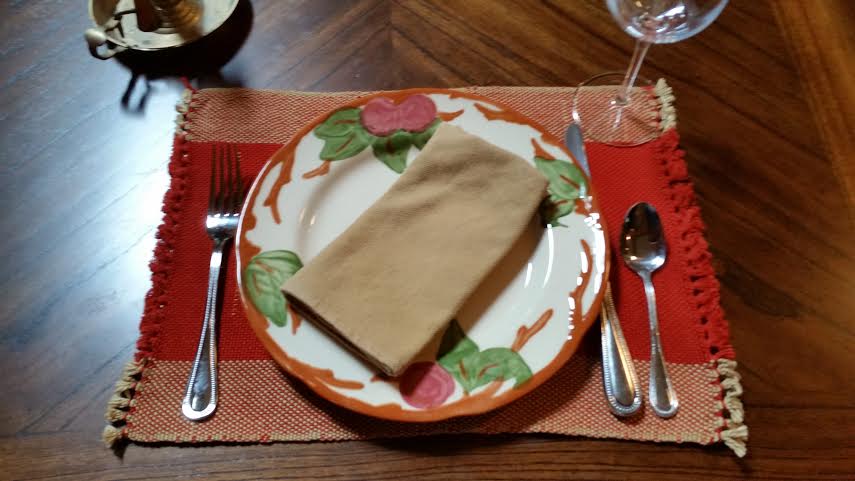

A Monteagle Sunset last Winter

Glyn & Will

Members of Handweavers Guild of America
 All Good Gifts